Get Full Government Meeting Transcripts, Videos, & Alerts Forever!
Get email alerts on the Human Services Budget topic
No spam. Unsubscribe anytime.
House human services subcommittee adopts H‑1 substitute for FY 2026–27 budget bill after fiscal overview and debate
Summary
The House Subcommittee on Human Services reviewed the House Fiscal Agency’s FY 2026–27 human services budget (House Bill 5605), questioned staffing and program cuts—most notably a $20 million removal of the Rx Kids prenatal/infant support program—then adopted the H‑1 substitute and reported the bill to Appropriations by a 4–3 vote.
The House Subcommittee on Human Services on July 8 reviewed the House Fiscal Agency’s recommendations for the FY 2026–27 human services budget and voted to adopt the H‑1 substitute for House Bill 5605 and report the bill to the House Appropriations Committee with a 4–3 recommendation.
House Fiscal analyst Sydney Walker told the subcommittee, “I am Sydney Walker with Cassie Uckman from House Fiscal,” and outlined the top‑line numbers: roughly $6.6 billion in gross human services appropriations and about $1.4 billion in general‑fund support for 2026–27. Walker said that represents about a 3.5 percent reduction in gross spending and an approximately $78.9 million (5.9 percent) increase in general‑fund spending; the package also reduces overall FTEs by about 5 percent to 9,855.8 full‑time‑equivalent positions.
Why it matters: The bill bundles numerous program adjustments and boilerplate changes that will affect child welfare, public‑assistance administration, juvenile justice, and local office operations. Major fiscal moves include caseload adjustments in child welfare lines, targeted grants for housing and food programs, and a set of TANF reallocations that finance other general‑fund needs.
Key provisions and changes: Walker highlighted a $40.3 million gross increase and roughly $69.5 million general‑fund increase for child‑welfare caseload lines (adoption, foster care, guardianship assistance), while operational alignments and lapsed‑savings estimates produce roughly $75.2 million in general‑fund savings and a reduction of about 409 FTEs across child welfare and juvenile justice. The budget adds $4.0 million for informal kinship care grants and $2.0 million for juvenile justice infrastructure capital improvements (with grant caps set at $100,000 per incident and $300,000 per facility). House Fiscal also proposed $1.0 million grants to nonprofits for child food distribution/education and $1.0 million in competitive nutrition grants, while eliminating funding for Kids’ Food Basket and Senior University (savings of about $925,000).
Work requirements and administrative changes: The package assumes federal changes tied to HR 1 and adjusts Title IV‑E and SNAP funding treatments. The House includes $22.5 million gross ($14.8 million general fund) and authorizes 150 FTEs to support increased casework expected from SNAP and Medicaid work‑requirement implementation. Walker said the state will run monthly state and federal database checks to confirm ongoing SNAP eligibility and will flag out‑of‑state EBT activity after 60 days for verification, with confirmed nonresidents referred to the U.S. attorney’s office.
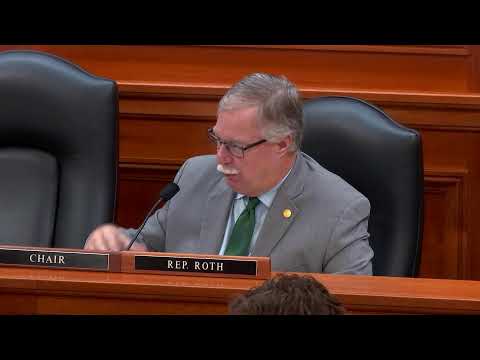
Member concerns: Representative Longchang pressed House Fiscal on the 150‑FTE estimate for work‑requirement processing, noting that, by his calculation, 150 staff would imply handling roughly 28,000 SNAP redeterminations and 35,000 Medicaid redeterminations annually and warned of downstream uncompensated care if families lose coverage. Longchang also questioned the $20 million removal of Rx Kids, citing evaluation claims that the program reduces premature births and other adverse outcomes and reported a 3:1 return on investment. Chair Roth replied that the budget shifts include roughly $90 million in TANF reallocation across budgets and offered to discuss details offline.
Votes and formal actions: Representative Kelly moved to adopt the H‑1 substitute for House Bill 5605; the roll‑call vote to adopt the substitute passed (reported 5 yeas, 2 nays). The subcommittee later voted to report House Bill 5605 as substitute H‑1 to the House Appropriations Committee with a recommendation; that motion passed on a 4–3 roll call. The clerk recorded the yeas and nays as read on the record.
What’s next: The bill, as amended by the H‑1 substitute, is scheduled to be considered by the House Appropriations Committee. Members who pressed for further analysis on staffing and the Rx Kids cut asked to continue discussions with House Fiscal and staff during the Appropriations process.
Reported by: House Subcommittee on Human Services transcript.