Get Full Government Meeting Transcripts, Videos, & Alerts Forever!
Get email alerts on the County Budget topic
No spam. Unsubscribe anytime.
County administrator proposes $614.8M FY 2026–27 budget, stresses public‑safety priorities and tax‑reform risk
Summary
Indian River County Administrator John presented a $614.8 million recommended budget that holds most millage rates steady, highlights public safety as the largest expenditure, and warns of multi‑year revenue impacts if state property tax changes pass.
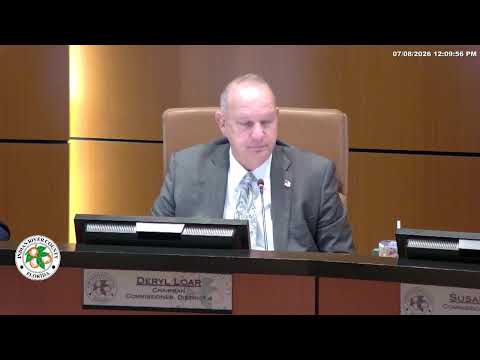
County Administrator John presented the Board of County Commissioners with a recommended FY 2026–27 budget of $614,800,000 at a July 8 budget workshop, saying the plan balances near‑term pressures while preparing for potential statewide property‑tax changes.
John said the recommended total represents a 13.6% reduction from the current mid‑year revised budget but is about 2.7% higher than last year’s originally adopted budget. He said the county is maintaining the millage rates for the general fund, the municipal services taxing unit (MSTU) and the emergency services district while the only millage increase in the package is for the 2024 land‑acquisition bond due to a second tranche issuance.
The administrator emphasized the county’s revenue mix and constraints. "Ad valorem taxes represent a large portion of our funding," John said, noting that roughly 52% of the county’s total budget and about 68% of the general fund are funded by property taxes. He told the board staff modeled 5%, 10% and 15% reduction scenarios for departments to understand implications if revenues decline.
Why it matters: John said public safety and constitutional offices consume the largest share of the general fund. "About 55¢ out of every dollar goes toward public safety," he said, adding that recent settlement and retirement cost increases and a 32% jump in health‑insurance costs significantly affect next year’s outlays. He warned that proposed state measures expanding homestead exemptions could reduce county ad valorem revenue by an estimated $22 million in the first affected year and much more thereafter.
Details and tradeoffs: The presentation reviewed fund types (general fund, MSTU, emergency services district, enterprise and internal service funds), the role of restricted special‑revenue funds (tourist tax, impact fees) and the limits on mixing them. John said some enterprise funds (utilities, solid waste, golf course) operate like businesses and don’t subsidize general operations. He also described recent steps to control costs, including selective zero‑based budgeting for large departments and quarterly fiscal monitoring.
Board response and next steps: Commissioners asked for clarifications on what "BCC operations" includes and on mandated costs the county must carry. John identified mandates such as Medicaid indigent‑care payments to local hospitals, the Guardian ad Litem program and school resource officer funding, and said those limits reduce the county’s flexibility. The board set tentative millage rates and scheduled the preliminary and final budget hearings for September.
The board will hold the preliminary budget hearing on Sept. 9, 2026, and the final hearing on Sept. 16, 2026. The recommended budget will be refined through departmental follow‑ups and, if necessary, mid‑year budget amendments.