Get Full Government Meeting Transcripts, Videos, & Alerts Forever!
Get email alerts on the Curriculum Review topic
No spam. Unsubscribe anytime.
Watertown Unified School District staff outline multi-year curriculum review, stress data and budgeting
Summary
District presenter Jenny described a draft seven-year K–12 curriculum review cycle, explained use of ESSER funds for past purchases, and highlighted an annual data baseline (Forward/ACT) compiled by Chris Malloy to measure effects of future adoptions.
Jenny, a district presenter, said the board should treat the document as a "working document" to track where curriculum materials stand and to ensure regular review: "this is something that I would like us to be reviewing at minimum annually." She said the plan is to align major adoptions on a K–12 timetable so the district does not conduct elementary, middle and high-school adoptions in overlapping years.
The document is intended to catalogue past purchases, forecast future needs and tie curriculum purchases to available funding. Jenny noted the district used ESSER funds for large curriculum purchases and emphasized that a review does not automatically mean a new purchase: "It doesn't imply that every time we review our curriculum, we're repurchasing a different curriculum." Any new purchase would still go through the business department and require board approval.
Jenny credited district staffer Chris Malloy with developing an annual baseline data collection process to compare student performance before and after curriculum implementation using state assessments (referred to in the meeting as Forward/ACT): "She has developed a process where she is collecting data each year...so that we can really compare what effects are we seeing within the curriculum." Board members praised the reporting but noted standardized state tests are a snapshot and asked about complementary classroom and teacher-based assessments.
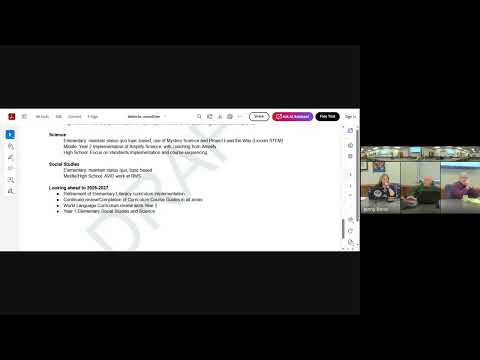
The presenter outlined subject-specific timing in the proposed cycle: secondary world-language self-study and potential site visits this year with a Spanish adoption proposal possible next year; German materials recently updated and not slated for immediate review; ongoing elementary literacy implementation and planned updates to curriculum course guides. Jenny said the district will use a 7-year cadence for curriculum course guide updates so the board sees smaller, staggered updates rather than multiple large adoptions at once.
Board members raised concerns about potential budget-driven cuts that could reduce rigorous course offerings. One member cited math-department work to preserve access to an advanced-algebra sequence and urged prioritizing graduation requirements. Jenny said staffing decisions are often enrollment-driven and reiterated the district’s priority to fund anything necessary to meet graduation requirements.
Next steps: curriculum course guides are expected in March, and Jenny said she anticipates bringing recommendations on some course guides to the board in February or March, with a target to present broader recommendations by May.