Get Full Government Meeting Transcripts, Videos, & Alerts Forever!
Get email alerts on the Parks And Recreation topic
No spam. Unsubscribe anytime.
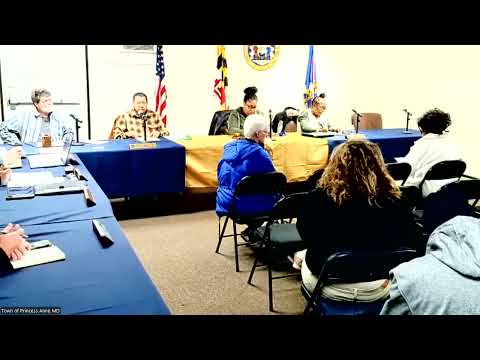
Princess Anne commissioners hear plan to repair Monoclon Park, weigh restroom options
Summary
At a Jan. 20 work session, the Monoclon Park Commission presented a phased plan to remove hazards, replace benches and picnic tables, and pursue a second grant to fund a restroom and additional amenities; commissioners asked staff to produce a site plan and scope for bidding.
Princess Anne commissioners on Jan. 20 heard a detailed presentation from the Monoclon Park Commission outlining safety hazards, repair priorities and funding options for Monoclon Park.
The presenter, identified in the record as the park commission’s presenter, said the park requires immediate attention: rusted water fountains and grills, broken benches and picnic tables, failing fence rails and a collapsed bridge approach. "This is the park renovation stage 1... It needs a lot of work," the presenter said, urging removal or replacement of unsafe elements before further improvements.
Why it matters: commissioners said visible hazards and poor maintenance deter visitors and make other investments — including a bandstand, picnic areas and trails — less useful unless the town budgets for upkeep. The commission framed the work as a mix of grant-funded purchases (benches, tables, receptacles) and town-funded site preparation and maintenance.
Details and costs: the presenter reviewed a vendor proposal and grant-eligible items and said the vendor’s proposal listed a picnic-table purchase-plus-installation total of $6,737.30. The presentation included an itemized playground-surfacing line of $7,107.28 and vendor estimates that starting a new restroom from scratch where no plumbing exists could be "at least $120,000." The presenter also recommended reusing or expanding the existing visitor-center/election-house restroom — which already has plumbing — as a lower-cost alternative. Several speakers noted the transcript contains inconsistent arithmetic in some handouts; commissioners asked staff to verify figures before contracts are issued.
Operational concerns: commissioners discussed how to prevent future misuse of restored restroom facilities. Historically, renters received keys via the police department with a small deposit; the presenters said that system broke down and the town currently uses porta-potties for events. Suggestions included limiting access to sanctioned events, using electronic locks, appointing an attendant for events, or raising the rental deposit (participants suggested amounts ranging from $50 to $500).
Procurement and next steps: commissioners advised the park commission to produce a formal site plan and scope to enable competitive bids. One commissioner said staff (identified in the meeting as Tim) can help develop the site plan needed for contractor bids. Commissioners also encouraged documentation of completed work to strengthen future grant applications and suggested the town consider maintenance funding in its upcoming fiscal budget.
Quotes and exchanges: Secretary (park commission) added an environmental concern about tree damage: "From the environmental side, this is killing the tree." A commissioner urged prompt work on the restroom, noting the difficulty of starting a new build without plumbing: "Get started on the bathroom sooner rather than later because it may be a while before we ever get one."
What happens next: commissioners asked staff to prepare a site plan and directed the commission to obtain contractor estimates and clarify grant reporting requirements. The commission said it will pursue a phase-2 grant for larger features if initial work is documented properly and the restroom strategy is resolved.
Funding and oversight: no formal contract awards or final votes on expenditures were recorded during the public discussion. Commissioners signaled intent to include maintenance and ongoing operating costs in budget planning before approving major capital work.
The presentation and follow-up discussion concluded with commission and commissioner agreement to pursue site planning, bids and clearer cost verification prior to bringing specific contracts or grant amendments back to the public agenda.