Get Full Government Meeting Transcripts, Videos, & Alerts Forever!
Get email alerts on the Access To Justice topic
No spam. Unsubscribe anytime.
Experts on LSC podcast outline barriers and local solutions to the rural justice gap
Summary
On the Legal Services Corporation podcast Talk Justice, LSC president Ron Flagg and guests identified shortages of attorneys, transportation and broadband as major barriers to civil legal help in rural America and discussed local pilots such as 'Lawyers for Learners' to expand access.
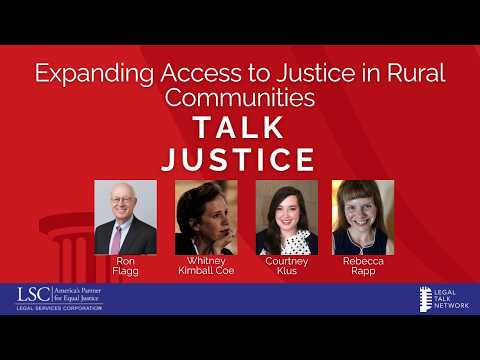
Ron Flagg, president of the Legal Services Corporation, hosted an episode of the LSC podcast Talk Justice focused on expanding civil legal help in rural communities and the new rural justice task force LSC launched to identify practical solutions.
Flagg said data from LSC’s Justice Gap report shows an acute shortage of legal resources in rural areas: “Around 20% of the nation's population resides in rural communities, yet only 2% ... just 2% of lawyers serve these communities,” he said, adding that nearly 10 million rural residents are income-eligible for legal aid funded by LSC.
That shortfall, guests said, meets a set of structural barriers. Whitney Kimbell Coe, vice president and director of national programs for the Center for Rural Strategies, described a broader civic problem: “The greatest barrier is this collective misunderstanding of what justice means and who it's for,” she said, arguing that a scarcity mindset and underinvestment can make rural residents feel their rights and problems are not important.
Courtney Klus, a staff attorney with Legal Aid of West Virginia, gave examples from frontline practice: transportation and connectivity hurdles frequently prevent clients from accessing courts, appointments or social services. “Do we have a way to get people to court? Do we have a way to get people to even appointments?... I'm at home and I have no cell service, or I don't have Wi Fi,” Klus said, explaining that lack of transit and broadband can make virtual remedies unavailable in practice.
Rebecca Rapp, an LSC board member and general counsel at Ascendium Education Group, emphasized the human consequences of too few lawyers in rural counties and described a ‘‘justice vacuum’’ that can leave institutions unchecked. Rapp outlined an outreach pilot, Lawyers for Learners, which places pro bono clinics at technical colleges and shifted to a virtual-hybrid model during the pandemic. Rapp said the pilot generated more than 1,000 requests for help and used colleges as local access points: “We use the technical colleges as the boots on the ground champions in these communities.”
Panelists discussed how the pandemic has heightened housing instability, eviction filings and stress on vulnerable populations such as veterans and survivors of domestic violence, increasing demand for civil legal help. They also noted assets in rural places: civic institutions such as libraries, technical colleges and community centers can serve as trust-building anchors and outreach platforms.
The guests and host focused on two overlapping strategies: bolster local capacity by growing the attorney pipeline and using nonlawyer navigators and local institutions to connect residents with legal help; and make technology useful in context by addressing broadband and device barriers so virtual services reach intended users.
LSC’s newly launched rural justice task force will gather examples and innovations from communities across the country, the panel said, with the goal of publicizing promising local models and helping scale solutions that increase rural residents’ practical access to legal rights and services.
The podcast closed with a standard disclaimer that guest views are their own and that the episode is for informational purposes, not legal advice.