Get Full Government Meeting Transcripts, Videos, & Alerts Forever!
Get email alerts on the Flood Insurance topic
No spam. Unsubscribe anytime.
Norfolk staff outline flood-insurance outreach, CRS progress and $25 million mitigation grant
Summary
City staff told the Planning Commission Norfolk remains a CRS class 5 community (25% NFIP discount) and described a refreshed Program for Public Information, data trends under FEMA's Risk Rating 2.0 and a $25,000,000 state grant to start voluntary mitigation efforts.
City staff presented an annual update on Norfolk's Community Rating System (CRS) and the Program for Public Information (PPI), saying the city's CRS participation dates to 1991 and contributes to a class 5 rating that delivers a 25% discount on National Flood Insurance Program policies.
"Our community is a class 5, and, our citizens get a 25% discount on their NFIP policies through participating in this program," the presenter told commissioners while explaining how PPI outreach and other CRS activities earn points toward the community's class rating.
Staff described the PPI as a data-driven public-engagement program. The presentation noted the committee that oversees the PPI must include at least 50% external stakeholders and that the city earned the maximum 350 PPI points, roughly 10% of the CRS points that factor into Norfolk's class score.
The presenter also walked commissioners through recent policy and data changes tied to FEMA's Risk Rating 2.0. "When they switched to Risk Rating 2.0, they removed the preferred risk policy," the presenter said, adding that the new actuarial method has made year-to-year comparisons difficult and that FEMA has shared limited detail about how the new rates are calculated.
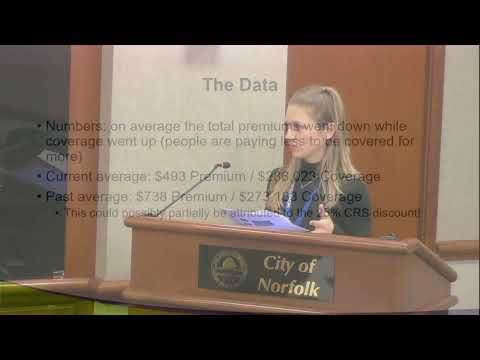
Staff presented NFIP-only data showing a decline in the number of NFIP policies and a shift in average premiums and coverage: the slide deck cited an average premium of about $493 for roughly $286,000 of coverage versus an earlier figure of about $738 for $273,000 of coverage. Staff cautioned those figures reflect NFIP data only; the city's dataset does not capture private-market flood policies. Staff reported about 8,500 active NFIP policies in the city.
As part of Norfolk's strategy to expand mitigation, staff announced the city was awarded $25,000,000 through the state's Community Flood Preparedness Fund. The grant will "kick start the voluntary nonstructural portion of the program," the presenter said, and is intended to support more home-elevation and other mitigation projects in repetitive-loss areas.
During questions, commissioners pressed staff on whether mitigation still creates a reliable premium incentive for homeowners. Staff reiterated that FEMA's Risk Rating 2.0 remains opaque to local officials, limiting the city's ability to quantify mitigation-related premium benefits for residents. Commissioners also asked whether larger structural projects such as the CSRM floodwall complex could change future maps and rates; staff said protected areas could eventually be remapped and that such projects may influence future insurance designations but timing and outcomes are uncertain.
The presentation closed with staff noting targeted outreach steps—mailings to VE zone properties and messaging for contractors and developers about substantial-damage and substantial-improvement thresholds—and with commissioners expressing support for continued public information.