Get Full Government Meeting Transcripts, Videos, & Alerts Forever!
Get email alerts on the Transmission topic
No spam. Unsubscribe anytime.
Rappahannock supervisors press FirstEnergy on pole heights, undergrounding and transparency for Page–Sperryville rebuild
Summary
FirstEnergy and Rappahannock Electric Cooperative updated the board on a proposed rebuild of the Page–Sperryville 138 kV transmission line; officials and many residents pressed the companies for pole‑height tables, right‑of‑way limits, construction methods and cost data and urged burying parts of the line in scenic village areas.
FirstEnergy representatives outlined plans Monday for a like‑for‑like rebuild of the existing Page–Sperryville 138 kV transmission line, saying the project will replace aging wooden H‑frame poles with weatherized steel monopoles and that a formal filing with the State Corporation Commission is expected in September.
Dan Tompkins, FirstEnergy’s project lead, told the Rappahannock County Board of Supervisors that the company has had extensive stakeholder conversations and will provide an outreach record in its state filing. "This is not a data center project," Tompkins said, stressing the filing begins a regulatory review process that will include public comment. He said pole heights vary along the route for engineering and terrain reasons and that the State Corporation Commission now has roughly a 9‑ to 13‑month clock to review transmissionline filings.
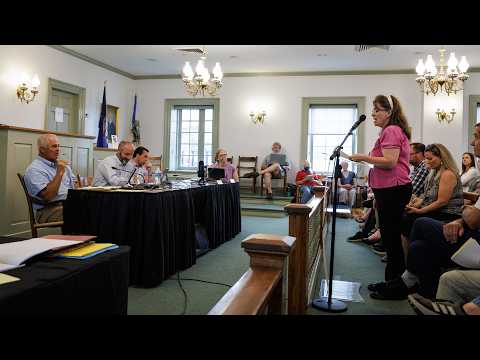
The presentation prompted sustained questioning from supervisors and dozens of residents who turned out for public comment. One supervisor urged FirstEnergy to keep wooden poles where feasible, limit any right‑of‑way expansions and bury at least 10–20% of the line in visually‑sensitive village sections. "I'd like to see wooden poles replaced with wooden poles," the supervisor said, adding that some residents see the project as tied to data‑center expansion and want assurances otherwise.
Residents and local groups pushed FirstEnergy for more transparency and for the math behind the company's position that undergrounding is "not feasible." "We have asked FirstEnergy to show their math on the proposed rebuild," said Sarah Parmalee of the Piedmont Environmental Council, calling for photo simulations and pole‑by‑pole engineering details that the public can review. Tompkins said the company would check with recipients of stakeholder letters before posting them on the project website but agreed to provide additional photo simulations and a pole‑height schedule if permitted.
Rappahannock Electric Cooperative (REC), which distributes power in the county, explained its role is in distribution coordination and that many distribution lines will need to be relocated or reattached to the new transmission poles. Jeff Henry, REC’s director of member services, said REC has been working with FirstEnergy on engineering coordination and that distribution upgrades aim to improve reliability for local customers.
On financing, FirstEnergy described how transmission project costs feed into PJM and then are allocated across distribution territories; the company said it could provide an overall project cost estimate but could not promise immediate bill‑impact numbers for REC members because allocation formulas are set by PJM and the relevant distribution companies.
Board members asked for clear next steps. Tompkins said when the company has a firm CPCN filing date he will notify the board and county staff before the filing posts to the SCC website and that the filing will include outreach documentation. The board asked staff to compile outstanding technical questions (right‑of‑way widths, pole‑by‑pole heights, construction access and undergrounding cost breakdowns) and press FirstEnergy for responses in advance of the SCC process.
Outcome: No formal action on the project was taken; the presentation and public comments will be part of the record when FirstEnergy files with the State Corporation Commission.