Get Full Government Meeting Transcripts, Videos, & Alerts Forever!
Get email alerts on the Bond Financing topic
No spam. Unsubscribe anytime.
Michigan City Area Schools OKs up to $185.55 million in bond authorizations for districtwide renovations
Summary
The board approved three resolutions establishing parameters for up to $185,550,000 in potential bonding to modernize elementary, K–8 and high school facilities, with officials saying the plan should not increase the district's debt service levy above 2026 levels.
Michigan City Area Schools' Board of Trustees unanimously approved three resolutions on May 26 that establish financing parameters for districtwide construction and modernization projects and set a maximum potential borrowing of $185,550,000.
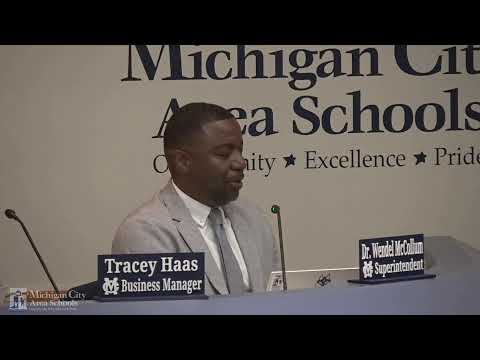
Superintendent Dr. McCullough opened the second of two required public hearings and introduced project representatives who detailed a plan to remodel three K–4 elementary schools, rebuild one elementary, renovate multiple K–8 schools with new athletic facilities and update mechanical, electrical and plumbing systems at the high school and across the district. Kevin Maguire presented the scope, saying the work is intended to replace aging infrastructure and improve safety, equity and instructional environments.
"Every student and teacher in the district will be positively impacted by this renovation," Maguire said, summarizing the project goals.
Municipal adviser Jason Tansil of Baker Tilly reviewed the financing structure. The board established a maximum borrowing amount of $185,550,000 to be issued in up to three series between 2026 and 2028, with repayment terms for each series not to exceed 20 years. Using an illustrative 5% interest assumption, Tansil estimated interest costs of about $112,954,000; the resolutions set a conservative maximum interest cap of 7% and a maximum annual payment not to exceed $15,806,000.
Tansil said the district's declining existing debt service schedule makes it possible to replace maturing payments without increasing the debt service levy above 2026 levels. "The school corporation is in a position to pay off these bonds without increasing its debt service levy over 2026 levels," he said.
Board members asked clarifying questions about taxable impacts and permitted uses. Tansil confirmed bond proceeds may not be used for operating expenses and explained that if the district did not borrow, the debt service levy would fall and bonding capacity would decline.
After the presentations and Q&A, a board member moved to approve all three resolutions establishing the project parameters, the preliminary determination for financing, and the path to a final lease or repayment schedule. The motion received a second and passed on a voice vote.
The approved resolutions set the parameters for staff to finalize the financing documents; the board was told final approvals and bond issuance steps are expected to return for action in June or July. No roll‑call vote or individual board vote tallies were recorded in the public transcript; the minutes record a voice vote and the motion passing.
Next steps include drafting the final resolution and lease documents required for issuance and returning to the board for final approval before bonds are sold.