Get Full Government Meeting Transcripts, Videos, & Alerts Forever!
Get email alerts on the Procurement topic
No spam. Unsubscribe anytime.
Central Health and Travis County explain how businesses can compete for local contracts
Summary
Central Health staff and Travis County Purchasing explained how vendors can register and bid, which platforms they use (BidNet, ESBD), how certifications are recognized, cooperative-contract use, a $10,000 spot-purchase threshold, and expected timelines (roughly three to six months).
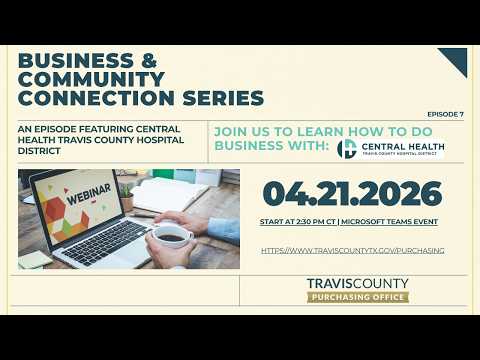
Central Health outlined steps for businesses seeking county contracts during a Travis County Purchasing webinar on April 21, 2026.
Margaret Castillo, senior business development analyst for the Travis County Healthcare District (doing business as Central Health), said Central Health posts solicitations and receives bid submissions through BidNet Direct and also posts for visibility on the Electronic State Business Daily (ESBD), but that Central Health accepts bids only through BidNet. "We post all of our solicitations, and receive all our bids on BidNet," Castillo said, and she offered to help vendors join the agency's bidders list.
The presentation emphasized that Travis County Purchasing and Central Health operate separate procurement processes and that businesses often need separate profiles to pursue opportunities with each entity. Kaleo Lopez, community liaison for the Travis County Purchasing Office, repeated that distinction and encouraged vendors to maintain profiles where required.
Why platforms and certifications matter
Castillo said Central Health recognizes multiple certification sources (city of Austin SMBR, the state of Texas, and regional certification organizations) and will accept documentation from out-of-state certifying bodies when vendors provide proof of status. The agency launched a business development program in January 2023, informed by a 2022 disparity study, to increase participation by historically underutilized businesses.
"We do recognize hubs," Castillo said, and she urged certified and noncertified businesses to register on vendor lists. Central Health also uses the Centralized Master Bidders List (CMBL) and other directories to compile availability lists for buyers.
Cooperative contracts and thresholds
Belina Bunch, senior procurement director at Central Health, explained why the agency uses cooperative purchasing agreements: they frequently mirror or exceed Central Health's contract terms, reduce negotiation time and satisfy mandatory procurement methods. "We try to use the cooperatives as much as possible," Bunch said, noting cooperative contracts can speed procurement when an appropriate vendor exists on a cooperative agreement.
Bunch confirmed Central Health's current spot-purchase bidding threshold is $10,000. "The $10,000 threshold is the one that we don't require bidding on; it is spot purchases," she said.
Bunch also told attendees that being listed on a cooperative does not automatically provide special consideration during selection. "It's not a hard no, but I'm gonna say no," she said when asked whether HUB/MBE/WBE vendors on cooperatives receive special preference; Central Health said it evaluates offers based on best value.
Practical steps and timelines
Panelists advised vendors to register on BidNet Direct and monitor cooperative partners (Choice Partners, Vizient, Sourcewell, OMNIA, TIPS, Texas DIR and others) because cooperative solicitations may not appear on BidNet. Castillo and Lopez recommended attending pre-proposal conferences, where Central Health asks firms to identify prime or subcontractor roles; the agency posts those lists to help prime contractors and small vendors connect.
On timing, Bunch said evaluation and contracting timelines vary depending on proposal volume and review-team schedules, but generally range from about three months to as long as six months when contracting negotiations or redlines extend the process.
Resources and follow-up
Castillo provided vendor contact information (chpurchasing@centralhealth.net) and offered to send availability lists or guidance by email. She and Lopez reminded attendees that the presentation materials and a PDF of the slides will be emailed to registrants and that a webinar survey was posted in chat.
Next steps
Lopez said the information presented is current as of April 21, 2026, and that vendors should verify details with Central Health procurement staff and cooperative partners. The webinar organizers also announced a June 10 session on financial resources with PeopleFund, LiftFund and the City of Austin.