Get Full Government Meeting Transcripts, Videos, & Alerts Forever!
Get email alerts on the Solid Waste topic
No spam. Unsubscribe anytime.
Commission debates broad RFP for solid‑waste site as a hedge against county disposal cost changes
Summary
Commissioners directed staff to craft a broadly worded RFP for the city‑owned solid‑waste parcel, prioritizing cost containment and allowing innovative technologies (diversion, composting, WTE, joint ventures) while seeking market feedback before deciding whether to sign the county interlocal agreement.
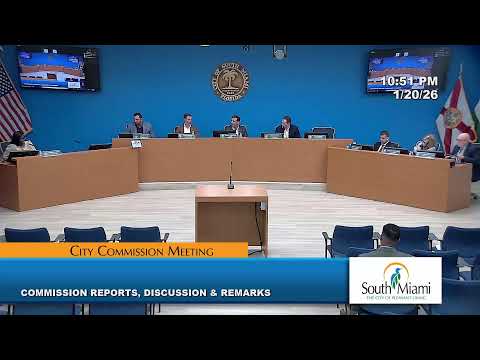
The South Miami commission spent an extended portion of its Jan. 20 meeting debating whether to pursue a city‑issued RFP to develop a solid‑waste facility on city property at SW 75th Avenue, and how that effort should be structured in light of pending county decisions about regional disposal and tipping‑fee changes.
Mayor Fernandez framed the issue as a protection against sharp increases in county tipping fees: "Cost containment should be the number 1 priority," he said, adding the commission needs options if the county’s interlocal agreement (ILA) results in substantially higher disposal charges. Commissioners expressed concern that a county transition to a waste‑to‑energy model and associated higher tip rates could materially increase the city’s disposal cost and passed a motion to have staff refine RFP language for consideration at the Feb. 3 goals meeting.
Commissioner Bonich urged the RFP to create room for "out‑of‑the‑box" proposals—energy recovery, biochar from green waste, or other innovative approaches—and recommended incentives for proposals that reduce landfill disposal. Commissioner Rodriguez said the solicitation should be simple and market‑focused to avoid driving up development costs that would undermine affordability objectives for other priorities.
Staff and counsel noted tradeoffs: strict experience thresholds could limit responses to incumbent large waste firms, while overly permissive language could invite speculative bids that are not financeable. The commission directed staff to revise the draft to balance minimum qualifications with a clear ability to accept joint ventures or technology partners, weight proposals that divert waste from landfills more heavily in scoring, and explicitly allow proposals that include assembling adjacent parcels when justified by a viable business case.
The commission discussed timing and market signals. Staff noted the manager technically may issue an RFP without a separate vote, but the body asked for a near‑final draft to be returned at the Feb. 3 goals meeting so commissioners can confirm priorities. Commissioners also reiterated the desire to coordinate with Coral Gables and the county where possible but not to be forced into an ILA that would leave the city exposed to unconstrained cost increases.
Next steps: staff/city attorney will redraft the RFP to (1) prioritize cost containment and revenue‑generating site uses, (2) allow multiple solution types (MSW handling if legally feasible, C&D and green‑waste diversion, composting, WTE or energy recovery through partner JVs), (3) include scoring that rewards landfill diversion and city revenue sharing, and (4) be reviewed by commissioners individually before Feb. 3. The city will use market responses to inform whether to sign short‑term county ILA options or pursue local alternatives.