Get Full Government Meeting Transcripts, Videos, & Alerts Forever!
Get email alerts on the Telecommunications Policy topic
No spam. Unsubscribe anytime.
Council hears debate over proposed ordinance to allow towers up to 300 feet for lakeshore cell coverage
Summary
Staff introduced Ordinance No. 344 to revise wireless facility rules and allow towers up to 250–300 feet in industrial zones to address lakeshore Verizon coverage gaps. Council members and residents expressed concern about tower height, proprietary Verizon coverage materials, FAA compliance and alternative solutions such as county siting services or mini‑repeaters.
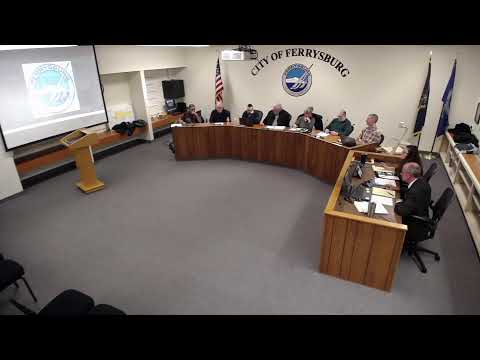
Ferrysburg City Council introduced Ordinance No. 344 on Feb. 16 to amend city code provisions for wireless communication facilities, satellite dishes and antennas, including a proposed allowance for towers up to 250–300 feet in specified industrial or port-industrial areas to improve lakeshore cell coverage.
Craig, city staff, said Verizon has approached the city about placing taller towers because the existing 75-foot limit would not provide reliable coverage along the Lake Michigan shoreline; staff reported Verizon suggested towers between 250 and 300 feet to clear dunes and reach shore areas. Planning commission recommended an amendment that would allow taller towers in light-industrial and port-industrial zones while removing the 75-foot allowance in residential areas and requiring any tower within 500 feet of a residence to maintain a 500-foot setback.
Council members and residents raised questions about FAA requirements for towers over 200 feet, potential flight-path conflicts with the Muskegon Airport and whether Verizon had provided verifiable, public coverage data. One council member urged exploring county-contracted, provider-agnostic siting services to identify co-location options and smaller solutions such as small-cell repeaters already used at North Shore Park. A resident and council members cautioned against placing a 300-foot tower in a three-square-mile city and asked staff to look for alternatives and confirm any FAA and airport implications.
Because this was an introduction, no permitting decisions were made that night; staff said any tower siting would still require site confirmation and planning-commission review as a special land-use permit or under the revised ordinance language.