Get Full Government Meeting Transcripts, Videos, & Alerts Forever!
Get email alerts on the Wireless Infrastructure topic
No spam. Unsubscribe anytime.
Planning commission recommends taller cell towers, strikes 75-foot residential option
Summary
After hearing proprietary Verizon coverage maps and resident testimony about summer outages and 911 reliability, the Ferrysburg Planning Commission voted to recommend City Council approve wireless-ordinance changes allowing 250'to'300-foot towers in industrial zones and struck a provision allowing 75-foot towers in residential areas.
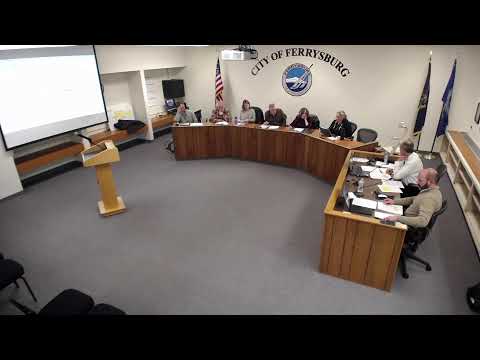
The Ferrysburg Planning Commission voted Feb. 5 to recommend City Council approve revisions to Chapter 154 that would allow wireless communication towers up to 250'to'300 feet in specified industrial zones, while removing a provision that would permit 75-foot towers in residential districts.
The recommendation followed a presentation by Logan Phillips of Telecat Engineering, speaking for Verizon Wireless, who showed January 2026 coverage maps he described as proprietary and said the carrier's engineers identified "hot zones" where calls and texts can fail. "The red is data that is, direct data back showing that calls can be dropped," Phillips said, adding that "calls to 911 may not go out" in the worst areas and that summertime congestion makes the problem worse.
Several residents urged action. Tom Godfrey of North Shore Drive said the lack of reliable service poses a safety problem: "We literally can't use our cell phone in our house during the summertime," he said. Bill Buck and Kevin Keeley also described minimal coverage along the waterfront and supported locating a taller tower away from homes.
Commission discussion focused on where taller towers could be sited and how to protect residential neighborhoods. Commissioners repeatedly emphasized preferring industrial or commercial parcels and using setbacks to keep towers away from homes. Commissioner Sandy moved that the Planning Commission recommend City Council approve the wireless ordinance amendments, including striking the 75-foot residential tower provisions; the motion was seconded and approved by voice vote.
Staff advised the commission that, if council follows the recommendation, the ordinance would proceed with a first reading on Feb. 16 and a possible second reading and adoption in March. Phillips and Verizon will be required to return with site-specific surveys, RF engineering studies, environmental reports and exact coordinates before any final siting is approved by the city.
The commission's action is a recommendation to City Council; site-level approvals will still require public hearings and special land use review as the carriers identify specific parcels.