Get Full Government Meeting Transcripts, Videos, & Alerts Forever!
Get email alerts on the Flood Mitigation topic
No spam. Unsubscribe anytime.
Crisfield council approves $20,000 to pursue $20 million FEMA flood mitigation grant
Summary
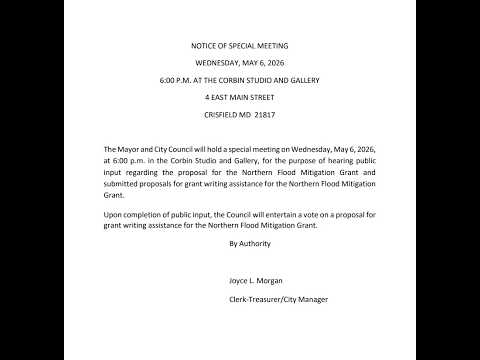
In an emergency session, Crisfield leaders approved spending $20,000 to hire engineering support to rework a previously submitted FEMA flood-mitigation application for the northern part of the city after program rules changed; council recorded 3 yes votes and 2 abstentions.
Mayor (speaker 1) and city staff told residents and council members that Crisfield’s multi-year flood mitigation strategy — developed with federal and state partners and previously rated the nation’s top application — must be reconfigured after FEMA changed the program rules. The restored FEMA program (announced in the presentation as restored on March 18, 2026) now bars phased submissions and lowered the grant cap to $20 million, Mayor (speaker 1) said, and the free “direct technical assistance” team that produced earlier engineering and feasibility work is not available for this round.
The mayor described the overall plan and timeline and said the southern portion of the project already secured a $36 million award; the northern phase was submitted but never reviewed after the program was paused. She told the council the city had identified consulting firms with relevant experience and that two firms (named in the presentation as Balance Hydraulics and Tetra Tech) said they could re-engineer existing application materials within the short timeline. "If we do not apply, there is a guarantee that we will not get it," the mayor said, arguing that the city should pursue the reapplication even though the scope will need to be reduced to fit the $20 million cap.
Council members and residents debated using local funds to pay roughly 10% of the application cost (the presentation showed two consultant price estimates in the $19,000–$21,000 range). Several speakers during public comment described repeated property flooding and urged the council to seize the opportunity. "We need that money," said Eleanor Barclay, a resident who said her property has worsened over the years. Leslie Lingle, representing a neighborhood watch, called the $20,000 a down payment on a much larger, needed investment.
Some council members pushed for more detail before spending the money. One councilmember (speaker 14) said she supported the project in principle but asked for clearer mapping and assurance that neighbors outside the proposed northern boundary would not be left behind. Staff responded that the consultants would rework the existing documents rather than start from scratch and that materials from the prior successful application were available to shorten the work.
At the meeting’s close, Councilmember (speaker 19) moved to "spend the $20,000 to contract with [the engineering firm named in the motion text] for support to apply for the $20,000,000 Northern Crisfield flood mitigation project." The motion was seconded and the council recorded a vote described in the transcript as three yes votes and two abstentions; the mayor said the motion passed. The council did not provide a roll-call list of how each member voted in the transcript.
City staff said the next steps include contracting the engineering firm and providing additional project details to council at an upcoming meeting (May 13 was cited in discussion) so members and the public can review the re-scoped design and proposed boundary. The mayor and several council members reiterated that the $20,000 expenditure is intended to unlock substantially larger federal funding to address chronic flooding, protect properties to roughly a 5-foot water elevation (presentation claim) and support long-term economic investment in Crisfield.
Notes on names and inconsistencies: the presentation and later motion used differing spellings and firm names in the transcript (Balance Hydraulics, Ballast Hydraulics, and a variant that reads Dallas Hydraulics). The transcript also contains differing descriptions of who paused the federal program; one speaker described the program as "closed" by the administration while another called it "frozen." The article reports those claims as presented at the meeting and avoids choosing between those versions.