Get Full Government Meeting Transcripts, Videos, & Alerts Forever!
Get email alerts on the Workplace Imposter Thoughts topic
No spam. Unsubscribe anytime.
Basima Tufek: Imposter thoughts can help workers rise to role overload, study finds
Summary
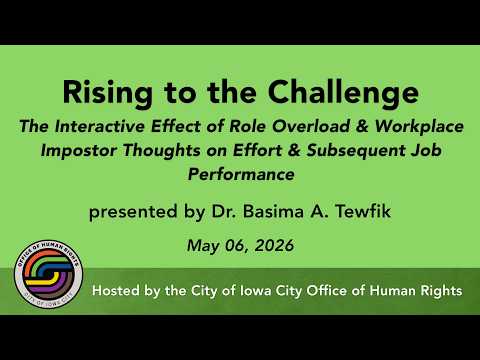
At an Iowa City Human Rights LENS webinar, MIT assistant professor Basima Tufek presented three studies showing that frequent workplace "imposter thoughts" can prompt increased effort and better performance under role overload, and that those gains did not clearly increase burnout in her samples.
Basima Tufek, assistant professor of work and organization studies at the MIT Sloan School of Management, told an Iowa City Human Rights LENS webinar that workplace "imposter thoughts" — the belief that others overestimate one’s competence — can sometimes prompt employees to exert more effort and improve job performance when they face role overload.
Tufek said the finding challenges the common framing of imposter phenomenon as uniformly harmful. "Research shows that 7 out of 10 working adults have entertained these thoughts," she said, and her research probes when that experience may be functional rather than only damaging.
The presentation summarized three studies. In Study 1, Tufek described a longitudinal field study of 169 employees at a legal outsourcing firm in which baseline performance ratings were followed by employee surveys and later supervisor ratings. She reported a positive interaction: among employees reporting more frequent imposter thoughts, higher role overload (feeling there is too much to do in too little time) was associated with greater self-reported effort and higher supervisor-rated performance. Tufek said those increases in effort did not correspond to higher burnout in that sample.
Study 2 was an experiment with 307 undergraduates randomly assigned to four conditions that manipulated perceived imposter feedback and perceived role overload. To induce overestimation in one condition, participants were given a fake aptitude score (up to the 91st percentile) and told their supposed partner expected strong performance; in the other condition participants received a message consistent with their own estimate (about the 56th percentile). Participants in the high-overload/induced-imposter condition transcribed more strings on the effort task, and they described the task as a challenge and reported greater task satisfaction. Tufek reported no clear increases in strain or turnover intention tied to the manipulated effort.
Study 3 surveyed 200 full-time U.S. employees to test mechanisms. Tufek said the results supported a challenge-appraisal pathway: employees with more frequent imposter thoughts were more likely to appraise role overload as a challenge (a valued gain), which explained the link from overload to increased effort and, in turn, to better performance.
Tufek put the magnitude in context, saying the interaction effect corresponded to a correlation around 0.2 and noting that small effects can still be meaningful in applied settings. She cautioned managers against a predatory takeaway: "Managers beware," she said. "The point of this paper is not to say, hey, if I want to overload my employees, maybe I should only just hire those who have imposter thoughts." Instead, she urged diagnosing workplace conditions and considering when imposter thoughts might be leveraged without creating harm.
The webinar concluded with questions from the chat in which Tufek distinguished imposter thoughts from simple self-efficacy (confidence) and invited follow-up by email and participation in future research. Kristin Watson, investigator for the City of Iowa City Human Rights, closed the session and reminded attendees the recorded presentation will be posted on City Channel 4 and remain available for one month.
The presentation covered study designs, sample sizes, manipulations, and measures; it did not commit the City or any agency to policy changes. Tufek encouraged managers and researchers to consider contextual factors before recommending that individuals suppress imposter thoughts.