Get Full Government Meeting Transcripts, Videos, & Alerts Forever!
Get email alerts on the Mobile Integrated Health topic
No spam. Unsubscribe anytime.
County hears case for funding mobile integrated health lead, third MIH paramedic and billing specialist
Summary
Douglas County commissioners heard Lawrence-Douglas County Fire Medical leaders explain supplemental budget requests to add an MIH team lead, a third MIH paramedic and an EMS billing specialist, and discussed pilot dispatching, vehicle and training needs, expected revenue impacts and partnership roles.
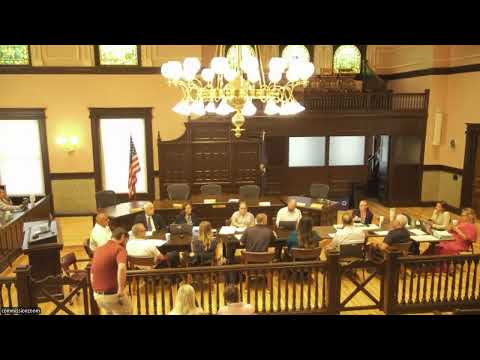
A Douglas County budget hearing on July 8, 2026 focused on supplemental requests from Lawrence-Douglas County Fire Medical (LDC FM) to expand its mobile integrated health (MIH) program, add EMS billing capacity and support emergency communications and station staffing.
Brooke, the county presenter for emergency services, opened the session with an overview of department operations and recent performance. She said the county’s emergency management office has four full-time staff (two positions supported by a federal Emergency Management Performance Grant passed through the state) and that the emergency communications center operates with 36 full-time staff; “99% of all calls were answered within 20 seconds,” she said. LDC FM reported responding to 12,666 EMS calls, 176 fire calls, 1,513 false alarms and 3,400 other service calls in 2025.
Why it matters: Commissioners were asked to consider three supplemental requests intended to increase MIH availability and to shore up billing operations. Supporters said the changes would let MIH operate in parallel teams, improve uptime, and allow testing of an alternative-response pilot that would route certain low-acuity dispatch determinants to MIH instead of an ambulance.
John Darling, division chief of EMS for LDC FM, told commissioners the MIH model relies on specialized training. “IBSC is the International Board of Specialty Certifications and community paramedic,” he said, explaining that community paramedic certification requires paramedic experience plus roughly six months of additional coursework and out-of-class study. Darling said that specialized training enables MIH clinicians to provide wound care, chronic-condition management, medication reconciliation and other services that standard emergency-focused paramedic shifts generally do not include.
Darling described three budget priorities: hiring an MIH team lead (an IBSC-certified paramedic who would provide frontline supervision and cover field duties), a third MIH paramedic to enable two simultaneous teams, and an EMS administrative specialist to improve billing recovery. He said the team lead would be in the field about half the time and that equipping a second MIH team requires both a staff vehicle and medical equipment comparable in total cost to a vehicle.
On pilot dispatching, Darling said the MIH program would work with dispatch to identify specific call determinant or nature codes for which the MIH team could be the primary responder. “When we have this 2nd alternative response in my team, these call types, these determinant codes, we would then send the mobile integrated health team as the primary response initial response,” he said, adding the pilot would be limited and data-driven — not a 24/7 substitution — until staff can validate outcomes.
Partnerships and outcomes: Staff said MIH already participates in local ‘familiar faces’ meetings with Lawrence Memorial Hospital and other partners to triage high utilizers. Darling presented unit-level measures indicating repeat EMS usage has fallen from prior years: he said the average calls per unique patient in a quarter is now about 1.5 for housed patients and about 1.75 for unhoused patients, a change he described as a more-than-50% decrease in repeat utilization versus five years ago. Commissioners asked for clearer, auditable numbers as they consider funding decisions.
Billing and fiscal questions: Commissioners pressed whether a billing specialist would “pay for itself.” Darling said LDC FM can bill for an ALS treatment without transport, but reimbursement is uneven; many insurers do not consistently pay for non-transport ALS treatment. He estimated it takes roughly a year to train a billing specialist and that revenue-recovery improvements would likely materialize after that training period. A commissioner noted a hypothetical $75,000 revenue target for covering a position and asked for clarity on timing and contingency plans if revenue gains do not meet expectations.
Operations and coverage details: Commissioners and staff discussed ongoing operational changes including intermittently and now full-time staffing of medic 6 after a May recruit graduation, the county’s recommended budget inclusion for Station 6 expansion and how medic units may be temporarily relocated for events. Staff reported that outside ambulance providers accepted many nonemergency transfers this year, reducing LDC FM workload by roughly 400 calls so far.
Emergency communications and event planning: ECC and emergency management leaders described efficiency gains from updated workflows and collaboration. Robert Panecke, director of emergency management, said the unified command used for recent World Cup planning yielded smoother-than-expected operations and stronger cross-agency relationships.
What’s next: Commissioners did not take final action on the supplemental requests during the hearing; staff said governance and shared-expense agreements with the City of Lawrence are under revision and further budget deliberations will follow. The commission recessed the session and scheduled a brief return at 10:05 a.m.