Get Full Government Meeting Transcripts, Videos, & Alerts Forever!
Get email alerts on the Paramedic Referendum topic
No spam. Unsubscribe anytime.
Fredonia fire chief outlines November referendum to fund permanent paramedics after county ARPA pilot
Summary
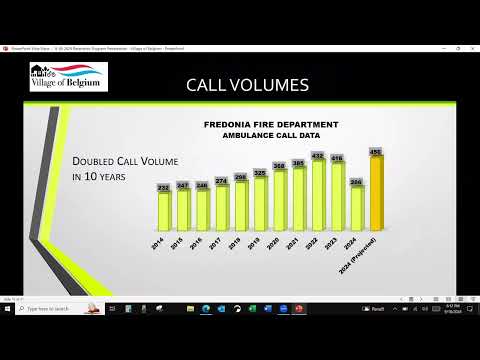
Fredonia Fire Chief Brian Weicker described a joint municipal paramedic program, funded initially by an Ozaukee County ARPA grant and now proposed for permanent funding via a village referendum that would cover a share of $510,000 in annual costs; supporters cited faster response times and recent lifesaving interventions while residents asked about tax impacts and long‑term sustainability.
Fredonia Fire Chief Brian Weicker on Tuesday laid out a plan to keep full‑time firefighter‑paramedics serving the northern third of Ozaukee County and asked voters in the villages of Fredonia and Belgium to approve a November referendum to help fund the program.
Weicker said the program began after a 2021 county review identified volunteer shortages and an aging population as threats to local emergency medical services. Ozaukee County awarded a grant to Fredonia — $648,000, he said — to start paramedic capability, with about $100,000 for equipment and the remainder for salaries and benefits through December 2025.
"We're providing you with the highest level of medical providers outside of the hospital," Weicker said, adding that the paramedic response vehicle now on display cuts average page‑to‑on‑scene time in Belgium to about 7.8 minutes versus mutual‑aid averages of 17 to 25.5 minutes. "Without a paramedic, we're putting our residents' lives at risk," he said.
The presentation traced local EMS history — volunteers and several mutual‑aid providers — and described recent hires: a full‑time paramedic in June 2023 (Josh), a second hire in October 2023 (Crystal), and a part‑time firefighter‑paramedic hired in May 2024 (Dean). Weicker said the three staff now cover roughly 60% of the paramedic schedule and that the program reduces volunteer on‑call burdens dramatically compared with relying on volunteers alone.
Officials said the county grant required municipal collaboration and a sustainability plan because county ARPA funds must be spent by December 2025. The program’s projected ongoing cost is $510,000 annually; the villages’ cost‑share formula combines call volume, equalized property value and an equal split and yields a village share estimated at roughly $152,000. The referendum question is expected to ask the village to raise its levy by about $149,600 annually, which officials estimated would be roughly $142 a year on a $300,000 home (about $3 a week).
Residents in the meeting asked detailed questions about how the cost split works, the tax impact after a recent reassessment and whether Belgium should pursue its own in‑house ambulance instead of the joint program. An agency official explained the three‑part cost formula and pointed to a tax‑impact calculator posted on the village website to help homeowners estimate changes.
Several residents urged passage. One resident said local crews cared for them recently and called the service "priceless," and Weicker described two incidents in which an on‑duty paramedic provided life‑saving care within 24 hours during the pilot period.
Officials acknowledged the program requires ongoing decisions about staffing levels and sustainability, noted the challenge of recruiting volunteers and younger recruits, and said municipalities are pursuing additional state and collaborative funding opportunities. The towns in the joint group will handle levy changes under different rules than the villages; the villages will place the referendum on the November ballot, officials said.
Next steps: the villages of Fredonia and Belgium will include the referendum on the November ballot; towns in the joint municipal agreement will seek levy increases under their budget processes. If voters approve the referendum, the municipalities would implement the levy change and continue planning staffing and capital needs for the program.