Get Full Government Meeting Transcripts, Videos, & Alerts Forever!
Get email alerts on the Stormwater Referendum topic
No spam. Unsubscribe anytime.
Key Biscayne council moves petition language to November ballot for $50M‑plus stormwater projects
Summary
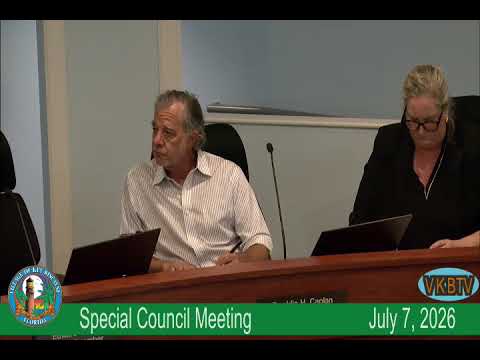
At a special meeting called to meet an election deadline, the Key Biscayne Village Council approved a resolution placing a voter‑sponsored charter amendment on the Nov. 3, 2026 ballot that would require voter approval for stormwater or flood‑prevention projects estimated to exceed $50,000,000 over a three‑year period.
The Village Council of Key Biscayne voted at a special meeting to place a petition‑sponsored charter amendment on the Nov. 3, 2026 ballot that would require voter approval for any stormwater or flood‑prevention effort estimated to cost more than $50,000,000 within a three‑year period.
The petitioners’ representative, who identified himself as Freeman of 201 Crandon Boulevard and said he spoke for the petitioners committee and the Key Biscayne Neighbors Association, told the council the committee collected 1,151 signatures in 44 days and asked that the ballot question remain verbatim to preserve what was presented to residents during signature gathering.
Staff explained the process required by the village charter. According to staff, the supervisors of elections certified signatures and the charter’s Section 6.02 obligates the council to place a certified petition on the next applicable ballot; the language of the petition was left unchanged except for a short title drafted to meet the 15‑word title and 75‑word question limits for the ballot.
Council members discussed wording in the draft, focusing on a proposed Section 9 (intent language) and Section 8 (a provision addressing conflicting amendments). One council member asked whether the term “flood prevention” was defined in the petition language; staff said the language does not include definitions and that ‘‘flood prevention’’ could conceivably encompass measures such as seawalls or shoreline renourishment.
A participant who supported the referendum also raised concerns about unintended consequences and logistics, asking how the village would proceed if an urgent, village‑required project exceeded the threshold in an emergency such as a hurricane. Council and staff responded that those implementation and scope questions would be considered separately if the amendment were adopted.
Council reached consensus to delete the questioned Section 9 from the draft language. A motion to approve the resolution calling a special election, as amended, was moved and seconded; council members voted in favor and the chair announced the motion carried. The resolution calls for a special election on Nov. 3, 2026, to submit the petitioner‑sponsored charter amendment to voters.
The meeting adjourned after the vote. The council made no final determination on implementation details or definitions in the petition language; those topics were discussed only as potential follow‑ups if the charter amendment is adopted.