Get Full Government Meeting Transcripts, Videos, & Alerts Forever!
Get email alerts on the Program Updates topic
No spam. Unsubscribe anytime.
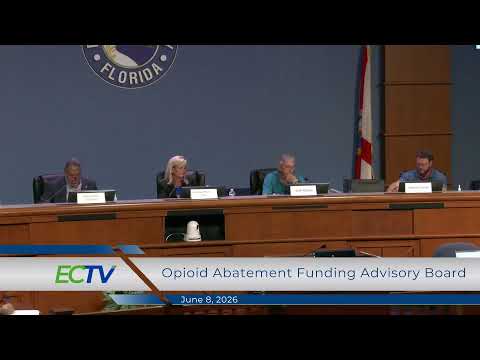
Opioid abatement board extends Ministry Village contract and hears program updates as OPUS wind-down begins
Summary
The board extended a contract for Ministry Village at Olive through May 2027, heard that the OPUS program will end June 15 after federal SAMHSA funding did not continue, and received updates from local providers including Hope Buffier, Lakeview AIM, YMCA, REAP and others.
The Escambia County Opioid Abatement Board on June 10 unanimously approved a time extension for Ministry Village at Olive's opioid abatement award through May 2027 with no change to the award budget, and heard implementation updates from several local providers funded by opioid abatement dollars.
Staff told the board that Ministry Village did not expend all previously awarded funds while completing construction of the Charis House building for a women's recovery program and requested extra time to finish the project. A motion to extend the contract was moved and seconded and the Chair declared the motion passed.
Program updates: an OPUS representative reported May outputs for the final months of that award: 32 boxes of naloxone (Narcan), 36 packs of fentanyl test strips, five wound-management kits, four HIV tests, three hepatitis C tests and roughly 50 outreach contacts. "The program officially ends on June 15," the OPUS representative said, explaining staff were being given time to transition to other positions.
OPUS and county staff said the program had continued beyond its original federal SAMHSA grant because board funds had been used as a bridge; program and staff representatives said SAMHSA did not renew the earlier funding stream this cycle. Staff described annualized operation costs as "north of $300,000" (the transcript also contains a separate unclear figure, "$3.34," which appears to be a transcription error). Board members and program staff said they will seek other funding sources where possible but acknowledged the service cannot continue without dedicated funding.
Other providers updated the board: Stephanie Shepherd, identifying herself in the transcript as "Stephanie Shepherd with Hope Buffier," said the county-funded diversion program has moved from pilot to serving all Escambia County high schools, is launching a youth-designed billboard campaign in August, and is testing a six-week, hour-and-a-half summer cohort to adapt for expanded school referrals. "We have successfully graduated now seven cohorts," Shepherd said, and she reported about 20 school referrals to date.
Patty Hyde of Lakeview AIM said the organization hired a new case manager and expected to expand caseloads; a YMCA representative said the YMCA is starting its first cohort with 12 participants and plans multiple cohorts over the year. REAP representative Vinny reported two houses in operation, recent staff hires (peer support specialist, program director, senior case manager) and current occupancy.
Staff also presented a published FY24—25 awardee report that will be posted on the opioid abatement website and circulated annually to summarize outcomes for fund recipients.
What happens next: staff will post the NOFA and annual report online; providers were reminded that the board-adopted NOFA timeline is tight and to prepare applications by the Sept. 11 deadline.