Get Full Government Meeting Transcripts, Videos, & Alerts Forever!
Get email alerts on the Housing Policy Inclusionary topic
No spam. Unsubscribe anytime.
Supervisors decline to advance countywide inclusionary housing ordinance or commercial housing‑impact fee
Summary
After a feasibility study, Ventura County supervisors directed staff not to develop a county inclusionary housing ordinance or a housing impact mitigation (commercial linkage) fee now, saying limited high‑density sites and modest projected returns made the measures unlikely to produce substantial affordable housing over the next decade.
The Ventura County Board of Supervisors heard a technical feasibility study on June 9 that tested whether the county should adopt an inclusionary housing ordinance or a housing‑impact mitigation (linkage) fee for job‑generating commercial projects.
Planning staff and consultant Economic & Planning Systems (EPS) told the board the county’s market and land‑use profile limits where mandatory inclusionary requirements could apply. EPS tested three development prototypes and concluded modest inclusionary requirements might be feasible — for example, roughly 5% moderate‑income for for‑sale projects and 5% low‑income for rental projects — but that those modest levels would be unlikely to produce much additional affordable housing in the unincorporated county given the limited amount of developable high‑density land.
On a commercial linkage fee, EPS found nonresidential development in the county is sparse (largely agricultural); between 2019 and 2025 there was only a single industrial project large enough to trigger a fee tied to generating 30 or more jobs. EPS recommended that a detailed nexus study, ordinance drafting and enforcement work would not be justified by the likely small returns.
Chinmay Damle of EPS summarized the study’s conclusions: “It may be feasible for the County Of Ventura to draft and adopt an inclusionary housing ordinance with modest inclusionary requirements,” but staff recommended monitoring housing production and returning if RHNA or market conditions change.
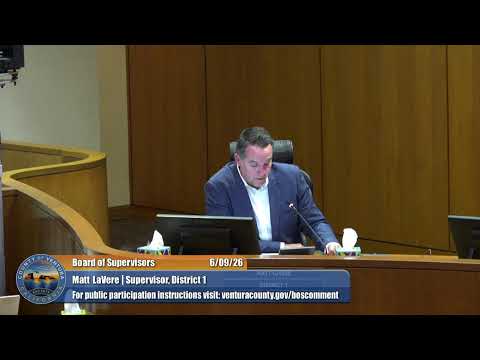
After public comments urging higher inclusionary percentages and more frequent review, multiple board members said the county’s record meeting RHNA targets, the very limited number of high‑density development sites, and competing staff priorities argued against devoting resources now to a linkage fee or ordinance drafting. Supervisor LaVere said the pro‑housing designations and permitting reforms staff are pursuing should have priority; Supervisor Long and others supported monitoring and revisiting the question if RHNA or market trends shift.
The board unanimously directed staff not to move forward at this time with development of an inclusionary ordinance or a housing impact mitigation fee and to monitor RHNA and market conditions for possible future return.
Next steps: staff will track housing production and RHNA outcomes and revisit the feasibility question at an appropriate midpoint of the next RHNA cycle or earlier if market signals change. The EPS study will remain part of the record for future consideration.