Get Full Government Meeting Transcripts, Videos, & Alerts Forever!
Get email alerts on the Education Device Policy topic
No spam. Unsubscribe anytime.
Westborough schools plan year‑long 'Yonder' pouch roll‑out to curb in‑class phone use
Summary
District leaders outlined a plan at a Town of Westborough forum to assign year‑long Yonder pouches to students, citing survey data, classroom focus and safety; the district plans staff training, medical exceptions, and a fall launch.
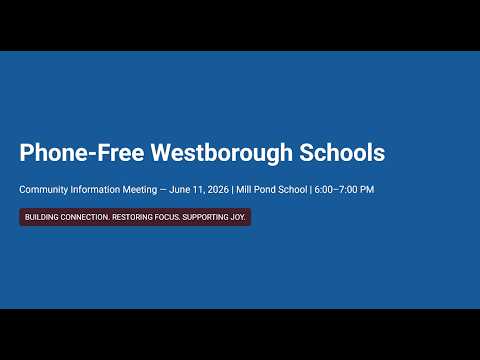
At a Town of Westborough community forum, district officials on July 9 presented a plan to require year‑long Yonder pouches for students to limit phone use during the school day and said they aim to launch the program this fall.
The presenter said the district’s goal is to reduce device distractions and improve classroom engagement while supporting students through training and measured follow‑up. “On the average, students have a cell phone, give 230 notifications a day, a quarter of which are happening during school hours,” the presenter said, arguing that uninterrupted learning time is being eroded by constant notifications.
Why it matters: administrators and staff cited three justifications for a districtwide pouch policy — classroom focus and learning outcomes, student mental‑health impacts from heavy phone use, and safety/communication during emergencies. Brian Callahan, the high school principal, said partial compliance under current classroom practices produces lapses in focus and occasional behavior issues that widen learning gaps when enforcement is inconsistent.
Survey data and student impact: A staff member described results from the district’s biennial student survey, saying the district saw a 20% increase in students spending more than three hours per day on phones and that students reported worsened concentration, disrupted sleep and negative effects on mental health. “Our kids are telling us this,” the staff member said, framing the planned policy as a response to student‑reported harms.
Safety and emergency communications: Chip Daphne, the town’s resource officer, told the forum that removing phones from classrooms reduced incidents of online bullying during school hours and made it easier to manage students in drills and real incidents. Administrators recounted a drill in which a middle‑school announcement accidentally played at the high school and quickly spawned false rumors; Brian Callahan said limiting phones can slow the spread of erroneous information that complicates emergency responses.
The proposed system and exceptions: Officials said the district plans to use the Yonder pouch system adopted by some nearby districts. Under the plan, each student would receive a year‑assigned pouch; devices placed inside are blocked while in the building and pouches are magnetized for quick release at dismissal. Presenters stressed pouches can be opened in emergencies and that police or other custodians can hold a magnet for off‑hours retrieval. The presenter said medical exceptions would be handled via nonlocking pouches for students with documented needs.
Training, measurement and accountability: District leaders emphasized staff training and a coaching approach so teachers focus on instruction rather than enforcement. The presenter said the district will use a Stanford survey tool to measure impacts and will hold additional community sessions over the summer. A replacement policy was described: a low‑stakes first replacement and full replacement cost after repeated losses to encourage accountability.
Next steps: Officials said they plan a fall launch, more summer outreach to families and ongoing check‑ins to monitor student adjustment. The presenter invited attendees to follow up individually with questions and said administrators will continue refining communication and support plans.
The forum was informational; no formal vote or policy adoption was recorded at the meeting.