Get Full Government Meeting Transcripts, Videos, & Alerts Forever!
Get email alerts on the District Goals topic
No spam. Unsubscribe anytime.
Hardyston board adopts five district goals and merit targets for 2025–26
Summary
Hardyston Township Board of Education on Aug. 12 approved five district goals — academic excellence, attendance and engagement, family/community partnership, positive school culture/staff collaboration, and long-range facilities/finance — and set merit targets for the superintendent including attendance and test-score growth.
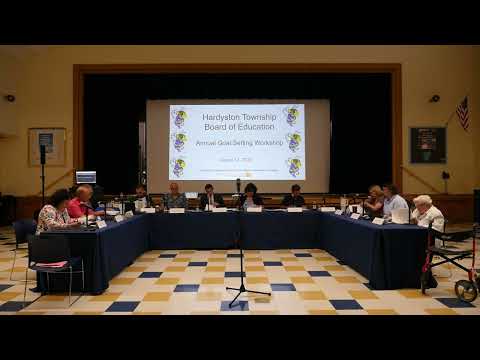
The Hardyston Township Board of Education approved five district goals and a set of merit goals for Superintendent Dr. Mike Ryder at its Aug. 12 workshop meeting, voting to send the merit goals to the county for review.
The board formalized district goals that emphasize academic excellence, reducing chronic absenteeism, strengthening family and community partnerships, sustaining staff collaboration and wellness, and developing a long-range facilities and finance plan. The superintendent outlined objectives and evidence the administration will use to pursue the goals, including teacher peer observations, expanded enrichment opportunities and projects to prepare students for secondary school.
Superintendent Dr. Mike Ryder told the board that electricians have completed the electrical upgrades required to bring air conditioning to the elementary school and that 29 classrooms will be outfitted before the start of the school year. He also reported required safety drills in July and said both buildings will participate in a “breakfast after the bell” program this year.
On attendance, board and administration discussion reviewed a recent downward trend in chronic absenteeism — from roughly 17% several years ago to 11.3%, and 8.4% in the most recent year — and a proposed merit-target of 5.9% or lower. Dr. Ryder described the approach as a two-pronged mix of family outreach (letters, meetings) and student-facing incentives and recognition.
Board members agreed to add long-range facilities planning as a district focus after a sustained discussion about triaging maintenance needs, cataloging broken systems, considering capital improvements (for example, an LED sign or playground) and exploring funding options ranging from grants to a potential referendum. The board noted roughly $750,000 in capital is available now but said longer-term financing and needs assessment remain priorities.
The board also discussed merit goals that will be used in the superintendent’s annual evaluation and tied to bonus pay. Those merit goals include quantitative targets for academic performance and attendance and qualitative objectives — for example, holding 10 community-dialogue sessions and documenting attendance and takeaways — with proposed survey-based measures of public and staff feedback.
The motion to approve the district and board goals carried in roll-call votes. The board president said the goals will guide the superintendent’s annual evaluation and will be posted on the district website with periodic updates to the board and public.