Get Full Government Meeting Transcripts, Videos, & Alerts Forever!
Get email alerts on the Time Capsule topic
No spam. Unsubscribe anytime.
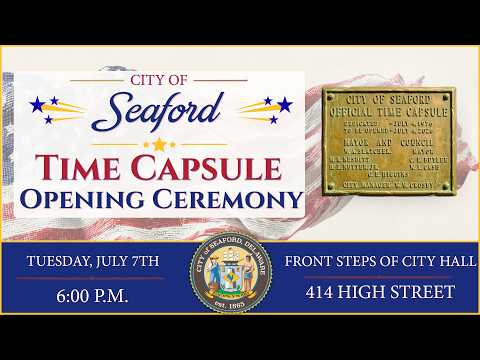
Seaford officials open 1976 bicentennial time capsule, reveal city records and letters to future mayor
Summary
City officials and residents opened a time capsule buried July 4, 1976, at Seaford City Hall, revealing municipal records, school materials, commemorative coins and personal letters; the city announced plans to collect items now for a new capsule to be reburied for 2076.
Seaford Mayor Matt McCoy welcomed residents and officials to a public ceremony that opened a time capsule buried during the nation’s bicentennial observances in 1976. “As mayor and on behalf of the city of Seaford, thank you all for joining us tonight,” McCoy said as the event began on the steps of City Hall.
Vice Mayor Dan Henderson led an invocation before attendees recited the Pledge of Allegiance. Local historian Jim Bowden of the Seaford Historical Society offered a short reflection, calling the capsule “a window into the lives of the people who came before us.” He urged the crowd to open the container together and “make a wonderful journey back to July 1976.”
Officials said the capsule was originally buried at City Hall (302 King Street) on July 4, 1976, and moved to its current location in 2004. Staff removed it from its burial site the day before the ceremony to prepare it for the public opening. Among the materials revealed were municipal documents (including a 1976 city code and a minute book of the Seaford Bicentennial Committee), a student roster for 1975–76, local guides and pamphlets, a telephone directory, posters and commemorative bicentennial coins.
The capsule also contained personal items and correspondence: letters addressed to family members, a message from Nanticoke Real Estate noting a planned completion of about 40 new homes in 1976, and letters directed to the mayor of Seaford in 2026. Mayor McCoy read portions of a 1976 message and a bicentennial pledge that affirmed the principles of the nation’s founders.
Staff noted a city manager’s instruction from Woodrow W. Crosby that specified heirs to receive certain items and directed that, if heirs could not be located, the capsule be held at City Hall under the city manager’s supervision; after one year the mayor could open the capsule and transfer contents to the historical society.
Organizers said they will assemble the items inside City Hall for close public review with preservation professionals present. McCoy announced the city is already collecting artifacts for a new capsule to be sealed this fall and opened in 2076; planned additions include a photograph of current city employees, letters from fifth-grade students at Frederick Douglass, a challenge coin marking the nation’s 250th and a state championship football.
The public was invited to continue the celebration inside City Hall once staff completes the display. “Thank you all very much for attending,” McCoy said in closing.