Get Full Government Meeting Transcripts, Videos, & Alerts Forever!
Get email alerts on the Housing Survey Portal topic
No spam. Unsubscribe anytime.
Dayton unveils 2025 housing‑condition portal to guide demolitions, citations and grant targeting
Summary
City staff presented the 2025 housing‑condition survey and a public portal that maps property scores (1–5), vacancy inventory and photo evidence to help prioritize demolitions, enforcement and grant applications. Officials noted 189 grade‑5 properties and roughly 1,600 structures on the structural‑nuisance list.
City officials on the Dayton City Commission unveiled the results of the 2025 housing‑condition survey and a new public portal designed to map property scores, photos and vacant‑land data to help target demolitions, enforcement and grant applications.
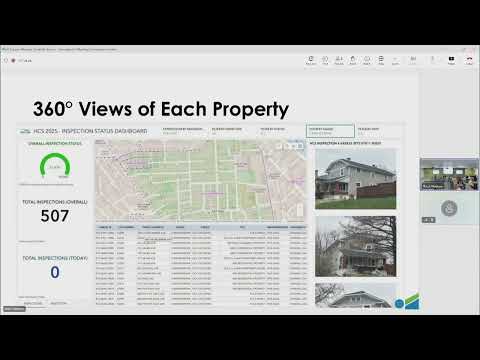
The portal, presented by Steve Donald, director of the Department of Planning & Enrichment Development, uses mobile‑app inspections and photo capture to record conditions in real time and lets staff and residents filter properties by neighborhood, score and specific repair needs such as roofs or foundations. "Every building, every building lot was captured," Donald said, describing the shift from paper surveys to a digital, photo‑driven approach.
Why it matters: the portal gives the city a uniform, searchable inventory to support requests for funding and to prioritize work. Donald said the 1–5 scoring system was preserved from 2023 so results are comparable; a score of 1 indicates preferred condition, a 5 indicates properties most likely to require demolition or intensive intervention.
Key counts and enforcement steps: staff said the 2025 survey added roughly 3,000 properties to the prior inventory by including some commercial corridors, and reported roughly 1,600 structures on the structural‑nuisance list (about 1,336 attributed to neglect or blight). The session recorded 189 properties rated grade‑5 citywide. James McDaniel, division manager for housing and inspections, said enforcement increasingly proceeds through civil citations: "So today we're close to around the 3,000 mark as far as issuing citations for various reasons," he said. The city is also updating Chapter 61 of the municipal code to clarify exterior and interior standards and refine legal orders and court processing.
Costs and funding context: the city reminded commissioners that its five‑year demolition plan concludes this year; the City Manager said removing the current inventory of grade‑5 properties would cost on the order of "4 to $5,000,000," and commissioners asked staff to provide consolidated ARPA spending and demolition totals as that program winds down.
Commissioner questions and next steps: commissioners pressed staff for clarity on how inspectors distinguish a score that warrants demolition from lower grades and asked for visual examples and site spot checks. Staff said the next steps are to crosswalk the structural‑nuisance list with survey grades, break out residential units for demolition priority planning, and present a detailed enforcement work session. Staff also said the portal will be posted to the city's website after the work session and searchable by address.
What remains unresolved: the session included inconsistent references to historic ARPA targets and demolition totals during questioning; staff committed to providing a consolidated briefing with exact ARPA spending, cumulative demolitions and the status of civil citations and legal orders. Officials also agreed to provide a memo about fire causes and any links to vacant or nuisance properties.
The commission scheduled follow‑ups: an enforcement‑focused work session and a demolition update in August. The portal posting and opportunities for commissioners and residents to conduct spot checks were cited as immediate next steps.