Get Full Government Meeting Transcripts, Videos, & Alerts Forever!
Get email alerts on the Homelessness topic
No spam. Unsubscribe anytime.
North Kansas City council weighs making camping ban permanent while seeking service partnerships
Summary
Council discussed whether to make a temporary camping-and-sleeping ordinance permanent, heard Kansas City staff describe a paired enforcement-and-services model and warned the city could lose federal homelessness funding without an ordinance, and directed staff to return an ordinance and a services plan at the July 21 meeting.
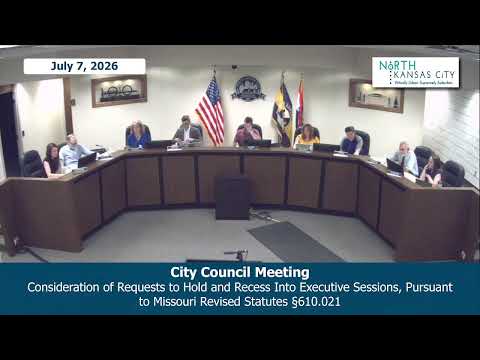
North Kansas City councilmembers spent the bulk of their July 7 meeting debating whether to keep elements of a temporary camping-and-sleeping ordinance after its July 21 expiration and how to pair enforcement with services.
Mayor opened the discussion by asking Chief Freeman to summarize local operational impacts and then introduced Josh Hinges from Kansas City, Missouri, who the mayor said serves as houseless prevention coordinator for KCMO. Chief Freeman told the council his department logged roughly 24–26 calls for service tied to camping or sleeping since the temporary ordinance took effect, described encampments on both private property near Harris Casino and on the levee, and said his officers encountered weapons and two felony arrests in recent weeks. "This is a camping and sleeping ordinance," Chief Freeman said, stressing it targets the establishment of camps on city-owned property rather than homelessness generally.
Josh Hinges described Kansas City’s approach to encampments and outreach, emphasizing a blended model that combines targeted enforcement with robust, low-barrier services. Hinges said Kansas City organized an encampment-scoring system (the Allen Index) to prioritize interventions, runs an outreach-heavy ‘‘clearance and closure with support’’ model and leverages low-barrier winter shelter capacity to connect people to longer-term services. "We had 938 cold-weather shelter beds last year," Hinges said, noting that centralized winter sheltering can be a critical opportunity to get people connected to housing navigation and treatment.
Hinges warned councilmembers that federal Continuum of Care scoring affects grant competitiveness: "If you don't have some kind of camping ordinance, I think you're automatically going to be 13 to 15 points behind every other city," he said, adding that without such policies North Kansas City risks losing federal funding targeted at homelessness responses.
Council members probed outcomes and logistics: several asked how many people the winter program moved into permanent housing, how many referrals resulted in uptake (Chief Freeman said officers handed out resource cards and that Turning Point had some connections but that only a few accepted assistance in some encampments), and what shelter costs look like. Hinges said the city pays roughly $50 per night for single-adult low-barrier beds and $80 or more for family placements, and that the most successful strategy is matching enforcement with commensurate services and case management.
Throughout the discussion, councilmembers repeatedly suggested a two-part approach: keep an enforcement ordinance available as a tool while directing staff to build and present a detailed services plan and partnership framework. Several members recommended separating the "camping" and "sleeping" provisions and building in clear guardrails (for example, defined notice periods and outreach-first procedures) so enforcement is not simply punitive.
Mayor and council settled on a next step: bring the existing temporary ordinance back on the July 21 agenda largely as written so North Kansas City remains eligible for federal funding, while staff and city leaders work with Kansas City and local partners to craft a companion services plan, implementation timeline and possible sunset or review clause. Mayor said he would meet with KCMO staff, the police chief and city administration in the coming weeks to develop that framework.
What’s next: Council directed staff to return an ordinance and a draft services/partnership plan for review on July 21. No permanent ordinance was adopted at the July 7 meeting.
"We can have one and the other, and we'll accomplish that goal," the mayor said, summarizing the council's consensus to pursue paired policy and service design.