Get Full Government Meeting Transcripts, Videos, & Alerts Forever!
Get email alerts on the School Sales Tax topic
No spam. Unsubscribe anytime.
Powhatan supervisors vote 5-0 to place 1% school construction sales tax referendum on Nov. 3 ballot
Summary
After presentations from county staff, school facilities and the county’s financial adviser, the Powhatan County Board of Supervisors voted unanimously to place a voter referendum on a 1% school construction sales tax on the Nov. 3 ballot; key questions about eligible items, farmers markets and the exact CIP numbers remain to be clarified during public education.
The Powhatan County Board of Supervisors voted unanimously July 6 to place on the Nov. 3 ballot a proposed 1% school construction sales tax, after hearing presentations from county staff, Powhatan County Public Schools facilities staff and the county’s financial adviser and debating revenue estimates and what purchases the tax would cover.
County staff summarized the new state-authorized local option and said it would not automatically impose a tax: "It does not automatically impose a new tax," staff stated, adding that the sales-tax authority requires voter approval and is limited by state law to school construction, major renovations and related debt costs and would end when the debt is repaid or no later than 20 years after approval.
Tom Sulzer, who spoke for the school division, said the schools have already documented their needs and framed the tax as a way to diversify funding beyond residential property taxes. "The key takeaway is that our facilities have already been identified," Sulzer said, citing a 2023 Dewberry facilities assessment and a school board-adopted 10‑year capital improvement plan.
Presenters and slides estimated an additional 1% would generate about $5 million a year; using conservative assumptions that revenue could support roughly $60 million (and perhaps as much as $80 million under more favorable scenarios) in debt affordability. Kyle Locks, the county’s financial adviser from Davenport, told the board jurisdictions often use a mix of cash funding and borrowing against the revenue: "you could and can cash fund capital projects in addition to borrowing against it."
Board members pressed several substantive questions before the vote. One supervisor noted the Dewberry assessment’s headline figure of about $80 million in deferred needs and asked how that related to a lower $60 million projection; staff said the figures reflect different methods and scenarios and that the slides displayed a conservative forecast. Another supervisor pointed out that the presentation’s sample backlog for FY28 listed $20 million while the slide items they added summed to about $14.9 million; Sulzer responded the slide was a sample of categories and not a full itemization.
Members also sought clarity about which purchases would be subject to the additional tax. Staff said the statutory language excludes many grocery items but makes prepared food subject to the tax — meaning fast food and similar prepared meals sold in the county would be taxed under the local 1% option — and flagged unanswered questions such as how farmers markets or certain small-producer sales (for example, jars of honey) would be treated under the state’s implementing rules.
Board members asked for concrete, comparable figures showing how much the property-tax rate would need to rise to generate the same revenue as the sales tax. Staff said preliminary calculations indicate that taking $60 million of debt would translate roughly to about 7.8 pennies on the tax rate in the example used; board members asked staff to produce a simple one-page comparison for public use.
On process, staff reviewed the calendar to place the question on the ballot: if the board adopts the initiating resolution now, the circuit court can order the referendum for the Nov. 3 ballot and the county would publish the statutorily required notices in the weeks that follow. Staff said election costs would likely be minimal if the question is tacked onto an existing ballot but acknowledged there will be staff time and outreach expenses to educate voters.
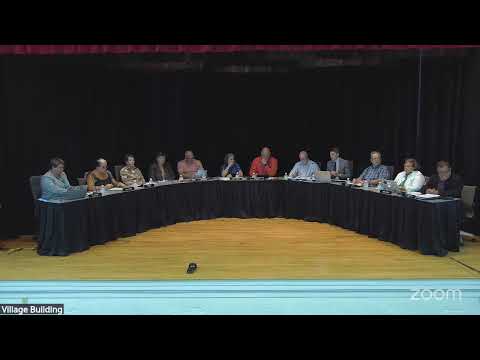
After discussion, a motion to put the referendum on the Nov. 3 ballot was made and seconded. The board took a roll-call vote and approved the resolution 5-0. The clerk recorded the ayes as: McClung, Power, Dr. Brown, Vice Chair Kinney and Chairman Donati. The board adjourned immediately after the vote.
Next steps identified by staff include developing a public-education plan, reconciling county and state definitions of eligible projects (to crosswalk the county’s capital thresholds with the state’s statutory language), and preparing a clear, comparative packet for voters that shows the sales-tax revenue estimate alongside the equivalent property-tax impact.
Action taken: the board’s resolution initiating the referendum process passed 5-0; the question will be before voters on Nov. 3 if procedural steps proceed as outlined.