Get Full Government Meeting Transcripts, Videos, & Alerts Forever!
Get email alerts on the Short Term Rentals topic
No spam. Unsubscribe anytime.
Crescent City council directs staff to audit STR TOTs after hour-long debate over neighborhood impacts
Summary
Council heard a detailed staff report and extensive public comment on short-term rentals, including options such as caps, owner-occupancy rules and local contact requirements. The council asked staff to prioritize transient-occupancy-tax (TOT) compliance checks and to return with refined housing-stock data and policy options.
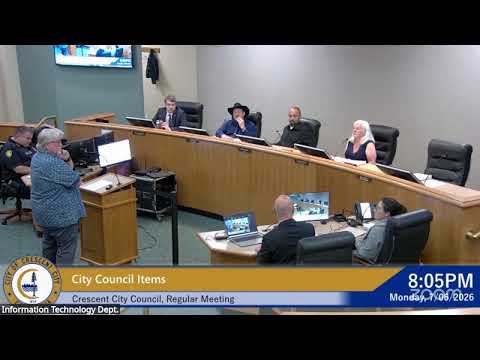
Crescent City councilors spent the bulk of their July 6 meeting debating how to regulate short-term rentals, with staff recommending several regulatory paths and members of the public offering sharply divided perspectives.
Staff presentation and options
Ethan Lawton, contract planner with SHN, summarized existing local code and permit types and presented data staff used to frame the conversation. He told the council there are two primary permitting paths for short-term rentals (STRs): ministerial approval as a home-occupation and a discretionary conditional-use path for formal bed-and-breakfast establishments. Lawton said the city’s business-license records currently identify 53 active business licenses that the staff classified as STRs and noted most are clustered along Pebble Beach Drive and similarly zoned residential areas. He explained that TOT (the transient-occupancy tax) applies to STR revenue, typically about 10 percent of rental receipts, and that SB 346 provides a mechanism for jurisdictions to request platform data from hosts and booking platforms to verify compliance.
Lawton outlined three regulatory approaches: (1) keep current regulations, (2) amend code to clarify and add targeted requirements, or (3) adopt a comprehensive STR ordinance with caps, owner-occupancy standards, safety inspections and local-contact requirements. He said comparable communities use a wide range of caps (1–15 percent), with many in the 5–10 percent range and some coastal communities setting different thresholds to preserve access.
Public comment and competing claims
Residents and STR operators gave competing accounts of local impacts. County resident Dave Garcia said nontraditional or “glamping” options can be affordable and hosted, serving visitors with limited incomes while leaving long-term rental stock intact: “They provide people an opportunity to make use of their space and bring in a modest supplemental income,” Garcia said (Dave Garcia).
By contrast, one speaker who identified as a long-time city resident argued STRs have hollowed out neighborhoods and reduced long-term housing availability: “It’s not a simple matter of just one problem…we need to get a handle on this,” the resident said (Speaker 12).
Owner/operator Mark Bauer, who identified himself as a vacation-rental owner, said most operators are responsible and the real problem is a small number of over-occupancy incidents: “Those people that put 20 people in a house that’s meant for 6 or 7 — that’s criminal,” he said (Mark Bauer).
Staff and council questions
Council members pressed staff on data detail and enforcement options. Lawton said the city could request platform-level data under SB 346, contract with third-party auditors (staff cited an example of a vendor used by another nearby city at about $500 per year) or ask platforms to remit TOT directly where that option exists. Staff also noted the reported figure for “total TOT receipts” in the staff slides appears anomalous and would be clarified — council direction emphasized getting accurate, comparable numbers (single-family units vs. all housing units) before deciding on caps.
Council direction
After public comment and discussion, the council reached consensus on two near-term actions: request information from booking platforms and prioritize verification of TOT remittance to identify and reach out to unregistered operators; and direct staff to prepare more granular housing-stock breakdowns (for example, single-family units versus apartment units) and options for regulatory approaches for a follow-up meeting when more members are present. The mayor said staff should start with outreach to Airbnb and VRBO and return with cost estimates for audits and clear statistics for single-family versus multiunit STRs.
Why it matters
Council members framed the issue as balancing neighborhood character and long-term housing availability against the economic benefits tourism brings to a small coastal city. Several speakers urged rules that keep a local contact for complaints and limit annual rental days, while others warned against overregulation that could harm small property owners who rely on rental income.
What’s next
Staff will contact platforms about TOT and data availability, request audit pricing, and present refined housing-stock and business-license analyses to the council at a future meeting. The council said a formal ordinance would return only after staff provides the requested data and options.