Get Full Government Meeting Transcripts, Videos, & Alerts Forever!
Get email alerts on the Water Policy topic
No spam. Unsubscribe anytime.
Morgan County holds first readings on wellhead protection and high-capacity water-supply ordinances
Summary
County officials heard a presentation July 6 from Interra consultant Liberty Flora on two draft ordinances to protect groundwater and review proposed high-capacity wells; commissioners acknowledged first readings and scheduled second readings for July 20.
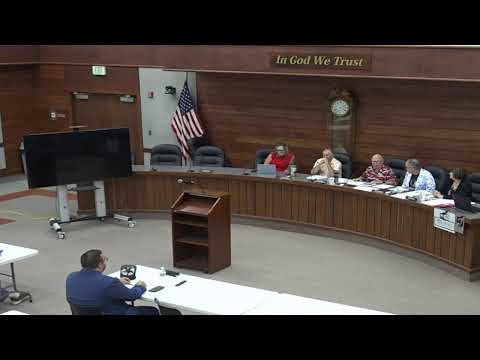
County Administrator Kyle Swallows told the Morgan County Board of Commissioners on July 6 that the county has been working with Interra since November 2022 on a county water study and is now seeking first readings of two draft ordinances addressing groundwater protection and high-capacity water-supply development.
Liberty Flora of Interra explained the Wellhead Protection Ordinance would use time-of-travel overlays (including a 200-foot radius plus 1-year and 5-year travel zones) based on state guidelines to identify areas where new construction or expansions would trigger a site-and-development review and possible coordination with the health department. "What this does is use existing state and federal guidelines, to as a proactive and preventative approach to water resource management," Flora said.
The companion Water Supply Development Ordinance would create a local review process for potential new high-capacity water users. Flora described zone-based thresholds and submission requirements: for example, projects proposing withdrawals greater than 2,000,000 gallons per day in high-potential outwash areas, or greater than 250,000 gallons per day in medium-potential areas, would have to provide geologic logs and pumping-test results (including 8-hour step tests) as part of an application so the county can assess impacts on existing users.
Kyle said the ordinances are part of a phased effort (phase two runs through Dec. 31, 2027) to maintain a water-monitoring network, evaluate aquifer impacts, and advise on sampling needs. Commissioners agreed a first reading was appropriate to allow public understanding and set a second reading for July 20 rather than suspending rules and voting today.
If adopted after the second reading, the ordinances would require affected developments to submit site narratives, contaminant details and technical data so the planning commission and county commissioners can review potential risks to public water supplies.