Get Full Government Meeting Transcripts, Videos, & Alerts Forever!
Get email alerts on the Sewer Financing topic
No spam. Unsubscribe anytime.
Greenwood council assents to up-to-$118 million sewer financing after Little Blue Valley presentation
Summary
After a presentation from Little Blue Valley Sewer District, Greenwood aldermen approved an ordinance assenting to up to $118 million in revenue bonds for Middleby Creek Subdistrict sewer improvements; the district said delays and FEMA floodplain work raised the project estimate and flow meters will be installed for future billing.
The Greenwood City Council approved an ordinance assenting to the issuance of revenue bonds that would raise the total authorized financing for the Middleby Creek Subdistrict sewer project to a not‑to‑exceed $118,000,000.
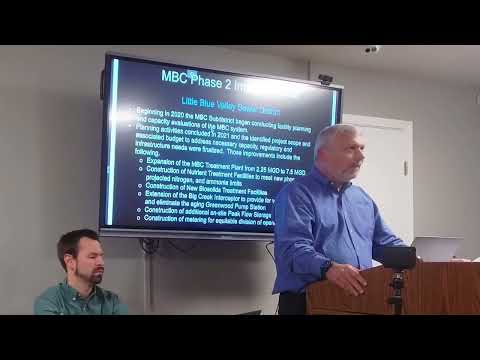
Jeff Shook, executive director of the Little Blue Valley Sewer District, told the council the project began with customer surveys and engineering work in 2020–2021 and was originally estimated at $106,000,000. "Back in 2020 ... it was estimated to be a total project cost of a $106,000,000," Shook said. He urged the council to assent to an additional authorization so bids will not leave the district short of funds.
Shook said FEMA floodplain remapping required an 18‑month modeling study that increased costs; he told the council the revised 2024 estimate is about $116,000,000 and the district is requesting an extra $2,000,000 cushion (for a not‑to‑exceed total of $118,000,000) but will borrow only the amount shown in executed contracts. "We did add additional 2,000,000 on this additional request of the 118,000,000 with the commitment that whatever bids come in at, that's what we're gonna borrow," Shook said.
The project scope described to the council includes roughly 3 miles of 36‑inch gravity sewer, manhole rehabilitation, cured‑in‑place lining, point repairs and storage structures to control peak flows. Shook said constructing treatment facilities at Pleasant Hill would reduce trucked biosolids and that the district plans to install flow meters at city connection points.
On rate impacts, Shook said the district currently bills customers by connections (about $44 per connection prior to the present request). Under the prior $106,000,000 estimate the projection would have raised rates to about $49 per connection; with financing options that extend loan amortization to 30 years the near‑term rate could be reduced (Shook gave an illustrative $47 figure). He described a transition plan: "we're gonna install these flow meters, and for 2 years, we're gonna read them but not use them" and share the data with customers before moving to flow‑based charges around 2027 using a multi‑year average.
Council discussion included technical questions about metering placement, why water meters cannot substitute for sewer flow metering, and how multi‑year averaging will smooth peaks. A resident said, "We don't wanna pay for this," expressing concern about cost allocation. Shook responded that the district follows a cooperative model and that customers who invest in reducing infiltration will benefit.
Shook also explained the legal approval threshold: state statute requires 75% of the Middleby Creek Subdistrict customers (six of eight) to approve the debt issuance; he reported five customers already have approved it and the remaining customer votes were scheduled in the coming days.
Council completed 1st and 2nd readings of Bill 2024‑87 (which will become Ordinance No. 2024‑3098 in the record) and voted to assent to the additional revenue‑bond authorization. The ordinance passed; the council chair announced the bill had passed and the city will record the ordinance number in the minutes.
The district and council said the next procedural steps include closing financing only after bids and contracts define the exact borrowing need and coordinating any loan terms with the Department of Natural Resources to manage repayment and rate impacts.