Get Full Government Meeting Transcripts, Videos, & Alerts Forever!
Get email alerts on the Extreme Risk Protection Orders topic
No spam. Unsubscribe anytime.
Portland police report surge in extreme risk protection orders; 47 issued so far in 2026
Summary
Sergeant Josh Silverman told the Community and Public Safety Committee on July 7 that Multnomah County-area efforts to expand extreme risk protection orders have produced 47 filings through mid-2026 — about seven times the historic rate — and described a bureau-wide training rollout and a grant-funded review plan to catch missed cases.
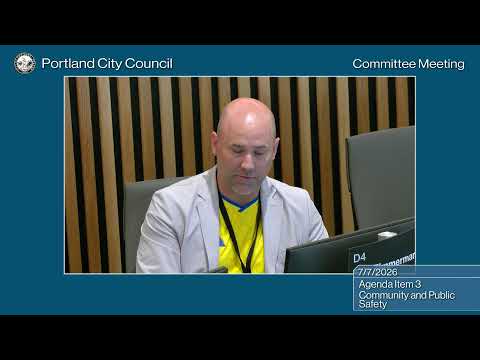
Sergeant Josh Silverman of the Portland Police Bureaus Behavioral Health Unit told the Community and Public Safety Committee on July 7 that the bureau has reached 47 extreme risk protection order filings so far in 2026, about seven times its historic rate.
Silverman, who the chair introduced as the bureaus subject-matter expert on IRPOs, said the increase followed three implementation phases: (1) building infrastructure and making the unit the point of expertise; (2) educating patrol to flag cases and refer them to the Behavioral Health Unit for e-filing and court work; and (3) training bureau-wide on how to complete IRPOs directly. He said administrative staff now handle court calendars, renewals and e-filing support.
The nut graph: City staff said the bureau has shifted from a referral model to expecting patrol officers and other bureau members to assess and apply for IRPOs when appropriate, while the Behavioral Health Unit continues to provide technical assistance and post-filing dispossession services.
Silverman described a training program that will run through December, including in-service classes in which attendees complete an IRPO as an exercise. The bureau is also pursuing a grant, he said, to fund a temporary team to review prior police calls for incidents where an IRPO might have been appropriate but was not filed; if funded, the review work would start in January 2027. He said the grant work would let enhanced-crisis-intervention trained officers (ECIT) apply missed IRPOs and then return to ECIT response duties.
Silverman outlined how IRPO dispossession works operationally: a gun-dispossession unit visits the subjects residence, educates the person about storage and legal obligations, and either secures the firearms or coordinates transfer to a responsible third party. He said the bureau prefers family safekeeping when feasible.
Committee members asked whether IRPOs are being applied equitably across demographic groups. Silverman said the bureau lacks detailed demographic disaggregation but that Oregon Health & Science University (OHSU) has a gun-violence prevention research group that provides richer data and could likely provide disaggregated analysis.
Several members also pressed how dispatch decisions determine whether ECIT, Project Respond or patrol responds to a mental-health-flavored call. Silverman said BOAC dispatch protocols set criteria (a set of seven dispatch triggers he described) for an ECIT response, and that BOAC sometimes redirects calls out of the police response entirely to crisis lines or the Multnomah County call center.
Committee Chair Novick congratulated Silverman and bureau leadership on the rapid increase in IRPO usage and the training effort. Silverman cited research he said shows every 17 to 23 IRPOs prevents one suicide (a claim he attributed to social-science studies from other states), and he said IRPOs are intended primarily for suicide prevention though they may also help prevent homicide, which he said is harder to prove causally.
The committee did not take formal action on the presentation; members requested future updates and more demographic data.