Get Full Government Meeting Transcripts, Videos, & Alerts Forever!
Get email alerts on the Special Events Police Funding topic
No spam. Unsubscribe anytime.
Riverhead board debates requiring private events to pay police costs
Summary
Councilman Rothwell and town staff discussed drafting a code change to require private-event organizers to cover police overtime after examples of high event-related costs; officials proposed fee models and exemptions for tourism-driving events.
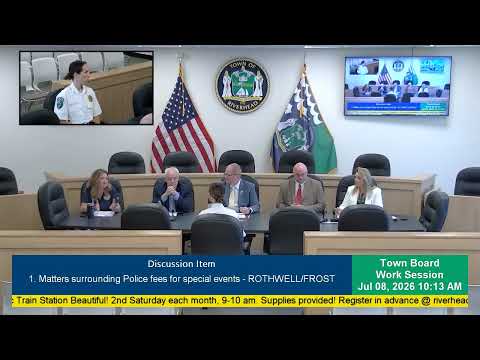
Councilman Rothwell urged the Riverhead Town Board on July 8 to consider requiring private-event organizers to cover police costs, saying recent private events on town property have imposed heavy overtime expenses on the police department.
"So we spent $9,300 on a on basically a private event," Councilman Rothwell said, describing one event at the Duck Pond in Wading River. He told the board the police fees for that event were "$56.70 in straight time and $3,500 in overtime," and said the town should not absorb those costs when private organizers profit from events.
The board discussed options for recouping costs. One council member described the village of Patchogue's approach, where vendors pay an application fee (she cited $150) and a portion is allocated to police services. "That's the way they do in the village of Patchogue," the member said as an example.
Captain Wilsey provided context from police records, saying the department in 2025 recouped roughly 20–30% of event-related costs. "It was almost a $112,000 spent and about $25,000 recouped from all the events," he said, noting the difference between total expenditures and recoveries as a concern for departmental budgeting.
Board members emphasized protecting long-standing tourism events that drive business to town — suggestions included having the town cosponsor signature events (e.g., the Polish festival, Duck Pond Day) while charging private organizers that do not provide townwide tourism benefits. A 30-day grace period for already-planned events was suggested so new rules would not retroactively penalize organizers who had begun planning.
The board did not take a vote on a code change at the work session. Members agreed to meet with the town attorney to draft possible legislation or code amendments and to continue the discussion; one timeline floated was making any new rule effective Jan. 1 to allow time for outreach and implementation.
Next steps: the board will consult legal staff and return to the topic in future meetings.