Get Full Government Meeting Transcripts, Videos, & Alerts Forever!
Get email alerts on the Library Insulation topic
No spam. Unsubscribe anytime.
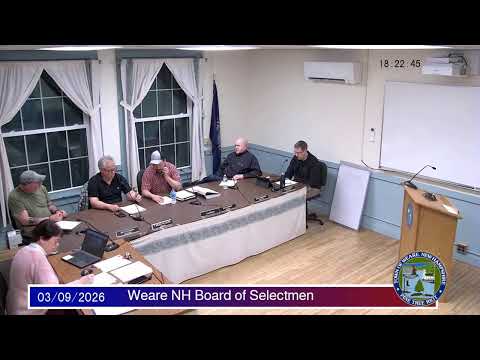
Weare library director asks Select Board for $4,851 to cover insulation project and vermiculite abatement
Summary
Library director Clay Creasy told the Weare Select Board on March 9 that a $10,119 grant plus $9,326 in trustee-encumbered funds leave a $4,851 shortfall to insulate the town library; contractors reported vermiculite that will require abatement if disturbed.
Clay Creasy, the library director, asked the Weare Select Board on March 9 for $4,851 to cover a shortfall on a library insulation project after a $10,119 Eversource (NH Saves) grant and $9,326 encumbered by the library trustees were applied.
Creasy said the building’s insulation is older than 35 years and that visiting contractors reported vermiculite in the older portion of the attic. “I am the library director, and I'm here for a funding request,” Creasy told the board, adding that contractors “both reported that we have vermiculite,” which raises abatement costs.
According to materials Creasy referenced, the vendor energy audit estimated the measures would save about $623 a year in energy costs and calculated a simple payback of roughly 14.2 years if the retrofit life is 25 years. Creasy said the project estimate itself (insulation and air sealing) was $8,849 before accounting for vermiculite-removal costs; he said vermiculite abatement could add substantially to the town’s portion of costs.
Board members asked for clarification about how the trustees’ encumbered funds were handled. Creasy said the trustees set aside $9,326 from last year’s surplus—principally employment-line savings—and intended those funds for insulation work but did not encumber money specifically for vermiculite removal. “If that money is not spent, it will still be in the town,” he said, noting the town would retain the unspent surplus.
The board discussed the technical choices and vendor bids. Members raised concerns about cellulose insulation’s moisture retention and suggested confirming whether contractors could substitute fiberglass at the same price. One member noted that EnviroVantage’s lower bid had a 30-day price validity and asked Creasy to verify whether the price would hold and whether fiberglass could be substituted without raising costs. Creasy said he had spoken with both companies and expected to schedule work in late April if pricing holds.
On next steps, board members asked Creasy to obtain written confirmation of any price holds or material substitutions and to return with an updated, written contract or estimate. The board did not make a formal funding motion during the public portion of this discussion; members instead instructed staff and Creasy to secure written bids and confirm whether fiberglass is available at the same cost before formal approval.
The library project is notable to the town because contractors reported vermiculite—an asbestos-containing material in some cases—and state/local rules require abatement if the material is disturbed during retrofit work. Creasy also said that the trustees’ $9,326 encumbrance came from employment-line surplus and would revert to the town if unused. He described the net project shortfall after grant and encumbered funds as $4,851 and the energy-audit annual savings estimate as $623.