Get Full Government Meeting Transcripts, Videos, & Alerts Forever!
Get email alerts on the Finance Recycling topic
No spam. Unsubscribe anytime.
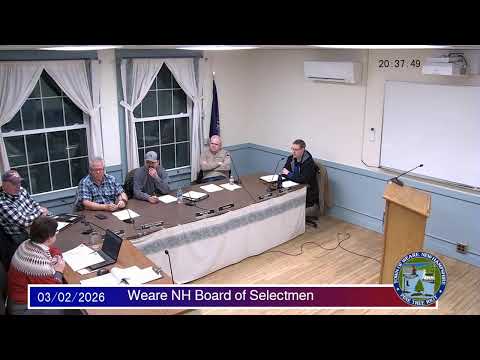
Weare Select Board closes hearing on proposal to send 100% of recycling revenue to transfer-station fund
Summary
The Weare Select Board held a public hearing on March 2 on a warrant article to allocate 100% of recycling receipts to the transfer-station special-revenue fund so that the fund would also pay hauling costs; staff and selectmen debated whether hauling costs could leave a net shortfall for the town budget.
The Weare Select Board on March 2 held a public hearing on a warrant article to change the town’s current split of recycling receipts so the transfer-station special-revenue fund would receive 100% of recycling revenue and the fund would pay hauling costs.
Chair opened the hearing at 7:03 p.m. and asked for public testimony on the article (pursuant to the warrant’s citation to 31:95-c). Director Jason Fiske told the board the change would channel all recycling receipts into the special-revenue fund and that the fund — rather than the general fund — would pay the trucking costs for recyclables. “The way it's gonna work, hopefully, now is a 100% of that money from recycling goes into the fund, and that fund also pays for the trucking,” Fiske said.
Selectman Frank Campana said he reviewed town budget documents and raised numbers-based concerns. Using townline items, Campana calculated hauling expenses for metal, loose paper and fuel that he said could total roughly $70,000 and observed that under some assumptions “we got less revenue than it cost us to haul the stuff.” Fiske and other board members reconciled the figures during the discussion: Fiske said gross recycling revenue in the past year was about $101,000 and hauling expenses would have been about $27,000, which he said would have left roughly $74,000 in the special-revenue fund if the town had captured 100% of receipts.
Board members emphasized that whether the town realizes a net gain or shortfall depends on which revenue and expense lines are counted (for example, demolition and trash lines are treated differently) and on the succeeding year’s budget vote. Chair reminded the meeting that even if the warrant article moves the receipts, any non‑trucking expenditure from the special-revenue fund still requires town approval under the usual article-and-budget process.
With no residents requesting time to speak, the Select Board closed the public hearing at 7:24 p.m. No final action to change the revenue split was taken at the session — the hearing provided public input and technical clarification ahead of voters’ consideration.
The board said staff will bring clearer accounting examples to assist voters in understanding how hauling costs would be handled in the proposed arrangement.