Get Full Government Meeting Transcripts, Videos, & Alerts Forever!
Get email alerts on the Land Use Permits topic
No spam. Unsubscribe anytime.
Planning board approves rural wedding venue with conditions after neighbors raise dust, traffic and well concerns
Summary
The Weare Planning Board approved a conditional permit for a wedding venue at 92 Helena Airport Road, requiring months of operation to be limited, a fire-department–compliant turnaround, and select-board approval before any application of calcium chloride for dust control; neighbors voiced concerns about noise, traffic and groundwater.
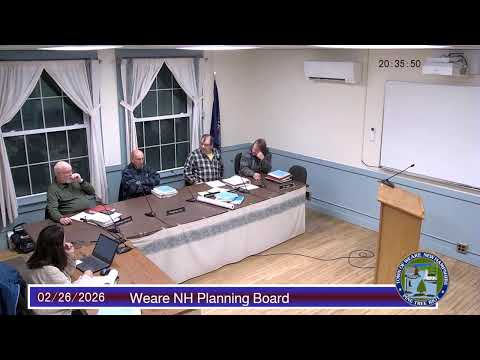
The Weare Planning Board on Feb. 26 approved an application to operate a wedding venue at 92 Helena Airport Road, adding three conditions: specify months of operation, construct a turnaround meeting fire-department requirements, and obtain select-board approval before applying calcium chloride for dust control.
The condition list was read into the record by a board member and the motion passed after a second and a voice vote. The board required plan notes to record the months of operation, the turnaround requirement, and the select-board approval step for calcium chloride application.
The applicant, who presented revised site plans and a note from Ares Engineering conditioning parking on continued common ownership of two parcels, told the board he had adjusted tent placement so it would be outside the 50-foot road setback and said he did not intend the venue to operate during mud season. “I don't intend it to be every weekend, but it could be,” he said, describing typical event timing as afternoon through evening during the drier months.
Neighbors at the public-comment period urged caution. Resident Liz Kenneth said the road already develops deep ruts and asked who would be responsible if increased traffic worsened conditions; she also raised noise concerns, saying in part, “the music stops at 10:00 at night,” and that late-night events would be disruptive to the rural neighborhood. Another neighbor questioned whether calcium chloride used for dust control could leach to groundwater and affect private wells.
The applicant responded that he would work to minimize noise by directing speaker placement and avoid operations during mud season, and that he would not apply calcium chloride in front of specific houses if that was a concern. “If dust is a problem for neighbors, I would be happy to apply or have the town apply calcium chloride. If you don't want it, I just don't do it,” he said.
Board members also reported input from town departments: public works indicated willingness to assist with dust control and recommended conditions; the police chief did not require a detail for routine events but said it could be added if necessary; and the fire department set an interior capacity of 80 and asked that the turnaround meet department standards. The board made the three conditions part of the approval and directed the applicant to update the final plan notes before signature.
The board instructed the applicant to follow up with the assessor to confirm whether temporary parking affects current-use designations for the field proposed as overflow parking and to provide full plan sets (metes and bounds and monumenting) before recording. The permit was approved subject to those plan-note additions and the select-board approval requirement for any calcium chloride application.
The board closed public comment, approved the motion, and the applicant was advised to coordinate plan signing with staff after submitting the final sheets.
The approval is conditional and includes follow-up tasks (plan updates and select-board coordination).