Get Full Government Meeting Transcripts, Videos, & Alerts Forever!
Get email alerts on the Solar Ordinance topic
No spam. Unsubscribe anytime.
Edgar County residents press board over drainage, setbacks and battery‑storage safety as staff prepares ordinance update
Summary
Residents of Edgar County told the board that large solar arrays, substations and battery storage planned near homes risk erosion, drainage and property‑value impacts; county staff said state rules and the Illinois AIMA limit how strict local ordinances can be but promised an amended ordinance and a public hearing.
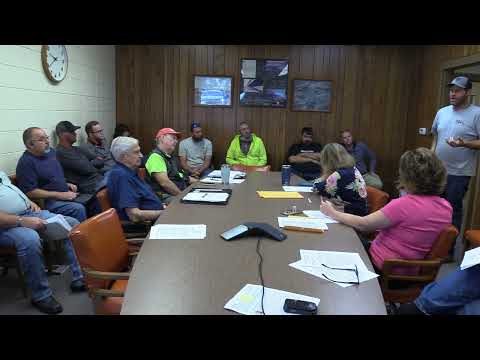
Several residents told the Edgar County Board on Monday that proposed solar projects and associated battery storage near their homes raise immediate safety and property‑value concerns, while county staff said state law and the Illinois Department of Agriculture’s Agricultural Impact Mitigation Agreement (AIMA) constrain what the county can require but that staff will draft amended local rules and schedule public hearings.
“My taxes have doubled. It cost me more to live in my home now… I prefer just to be completely bought out by this place,” said Kyle Minhiam, a farmer who said a planned 175‑megawatt substation and a 96‑container battery storage facility would sit in front of his house and asked what the county could do to “make our lives better.”
Why it matters: Residents said the projects could worsen existing erosion and drainage problems on local roads and fields, create noise and visual impacts, and depress home values. County staff and board members described a multi‑step review process that includes compliance with AIMA, a road‑use agreement and a building‑permit stage where detailed drainage plans and mitigation measures are reviewed. Staff said the county cannot write local rules that are more restrictive than state law but can negotiate additional community benefits with companies.
Staff and board response: A county planning staff member told residents the AIMA governs many agricultural‑impact requirements and that the county’s review becomes more detailed when applicants submit building‑permit materials. The county’s legal office said it will prepare amended ordinance language to reflect recent state changes and will publish the edits for a public hearing and subsequent county‑board vote. The board chair indicated those items will be put on a future meeting agenda for consideration.
Residents’ requests and safety concerns: Speakers urged the county to require baseline photo documentation of neighborhoods before construction, to clarify fencing and ground‑clearance standards so wildlife are not trapped, and to set screening and tree‑planting standards that provide privacy to adjacent homes. A local fire chief warned battery‑storage fires present special hazards and urged training and clear response plans for first responders.
Tax and community benefit discussion: County staff summarized how project revenue would be distributed under state rules and said megawatt‑based assessments can generate significant annual payments that are distributed like other property taxes, with school districts receiving the largest shares. Several residents called for using company negotiations to secure local benefits such as road repairs, drainage improvements or community investments.
What happens next: The state’s attorney told the board she will draft an amended solar ordinance to incorporate recent state changes (as described at the meeting) and to add explicit farmland drainage‑plan filing requirements; that amendment will be released for public hearing and then brought back to the board. The county said formal road‑use agreements and building‑permit reviews typically come later in the process and that companies can still voluntarily agree to higher financial assurances or community benefits than the ordinance requires.
The meeting closed without any final vote on an ordinance; the county indicated a public‑hearing schedule and amended language will be prepared for a future board meeting.