Get Full Government Meeting Transcripts, Videos, & Alerts Forever!
Get email alerts on the Zoning Updates Adus Strs topic
No spam. Unsubscribe anytime.
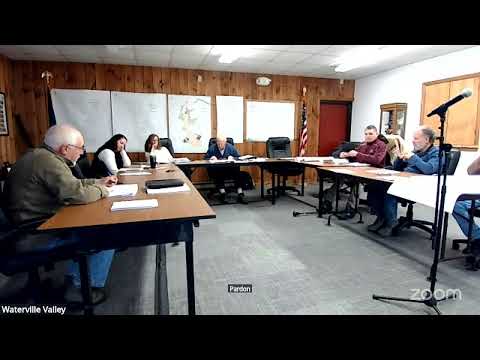
Planning board hears SC Group recommendations on zoning, moves to bar ADU short-term rentals
Summary
Consultants presented a package of zoning and site-plan updates for the resort town, recommending changes on impervious coverage, architectural standards, workforce housing unit sizes, and short-term rental rules; board members signaled consensus to prohibit ADUs being used as short-term rentals and to limit one ADU per lot.
The Waterville Valley Planning Board received a detailed presentation from SC Group consultant Julia on Nov. 13 outlining recommended changes to the town's site-plan, subdivision and zoning regulations tailored to a resort community.
The consultant highlighted proposed updates including: specific impervious-surface limits (with waivers where mitigation is demonstrated), clarified stormwater and culvert requirements, stronger language on buffers, and the addition of resort-specific design guidance and architectural standards to manage large-scale resort development impacts.
On workforce housing, the consultant recommended lowering minimum unit sizes to make smaller, more feasible units practical for developers: a proposed townwide minimum of 1,200 sq. ft. (down from 1,500) and a PUD bonus minimum down to 1,000 sq. ft. Board members debated local construction costs and financing, noting examples of existing inventory and high per-square-foot construction costs.
Short-term rentals and ADUs were a central topic. The SC Group suggested clarifying the STR definition and strengthening enforcement; the planning board's working group reported a consensus that ADUs (both attached and detached) should be prohibited from being used as short-term rentals. The board also discussed limiting ADUs to one per lot, maintaining single ownership of the primary dwelling and ADU (to prevent separate conveyance), and treating existing ADU STRs as grandfathered subject to permit expiration rules.
On definitions and process clarity, members proposed replacing the word "restaurant" with the state's broader "food service establishment" to accommodate mobile food vendors and food trucks in appropriate zones, and discussed where such uses should be allowed or limited (for example, whether to allow accessory food service in the Special Civic zone). The board also discussed adding explicit definitions for "structure," "wall," and other terms to avoid ambiguity.
Julia said the recommendations are intended to be regulatory starting points the board can adopt and then fold into site-plan and zoning language for voter consideration. Staff (Liz) said she will draft redlined warrant articles incorporating the board's agreed changes and circulate them for review; the board will schedule public hearings and coordinate legal review and Selectboard timing ahead of Town Meeting.
Board members emphasized the need to move efficiently: many of the changes align with recent state statute changes and with public priorities such as housing and safety, but each amendment will require public notice and, where applicable, voter action.