Get Full Government Meeting Transcripts, Videos, & Alerts Forever!
Get email alerts on the Rsu 18 Budget topic
No spam. Unsubscribe anytime.
RSU 18 voters approve $47.16 million budget; municipal assessments total $20.34 million
Summary
At a regional budget meeting, voters approved RSU 18's proposed $47,157,904.19 budget and related appropriation articles, including municipal assessments of $20,340,695.52; key discussion focused on special-education enrollment, a $500,000 technology lease, and traffic at the Williams Building.
RSU 18 voters at a regional budget meeting approved the district's recommended operating budget, adopting a total FY2026 budget of $47,157,904.19 and approving municipal assessments that total $20,340,695.52 after hand-count ballots.
The vote on Article 14, the district's total budget for the year ending June 30, 2027, carried by a hand count announced as 51 in favor and 4 opposed. Earlier hand-count results showed Article 12 (setting the district's total cost and municipal shares) passed 50-3, and Article 13 (additional local funds exceeding the state's Essential Programs and Services allocation) passed with a hand count announced as 49 in favor and 12 opposed.
Why it matters: the approved budget sets tax assessments for the district's five member municipalities and funds classroom instruction, special education, transportation, facilities, and ongoing technology replacement. The meeting included extended discussion of special-education enrollment trends, a recurring $500,000 technology lease intended to smooth replacement costs, and neighborhood traffic congestion at the Williams Building.
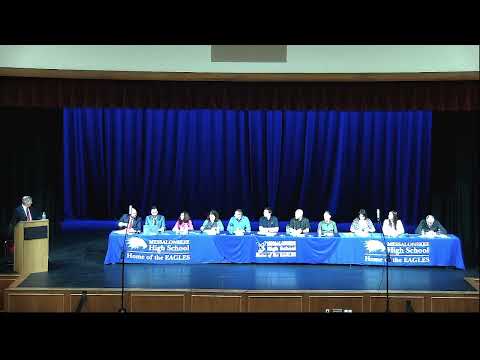
The meeting began with a procedural vote to elect a moderator. Jim Israel, who identified himself to the meeting as moderator, presided for the remainder of the session after the board moved to elect him and the motion was carried. The moderator read each article in order and called for motions, discussion, and votes.
Budget totals and municipal shares: the board reviewed line items and recommended amounts across multiple articles. The regular instruction appropriation under Article 1 was read as $20,848,076.69 and adopted. The special-education appropriation in Article 2 was recommended at $7,268,091.21 and was adopted after questions about an increase in the special-education percentage.
Special education: Cheryl Mercia, identified in the meeting as the district's special education director, explained that the increase in special-education counts reflects changes in how some students are counted. "So the numbers that are represented don't have an offset for Erskine Academy," Mercia said, explaining the district counts special-education students who attend Erskine while regular-education students from Erskine are not counted in the same way. She also said two special-purpose private schools now count as district students only if they have Individualized Education Programs, and that the district has seen about 40 incoming kindergarteners with IEPs this year. Mercia framed these changes as district-wide factors that raised the special-education totals.
Technology lease and local funds: Article 13 asked voters to approve $9,756,607.87 in additional local funds above the state EPS allocation. Board member Sherry questioned a $500,000 technology item referenced in the superintendent's materials and asked whether that money could be returned to taxpayers if it was not needed. The superintendent explained the $500,000 represents a technology lease payment that funds an annual replacement cycle, which helps avoid large spikes in the budget. "We use a technology lease to fund...our replacement cycle every year," the superintendent said, adding that the revenue side of the budget also includes $800,000 in carry-forward funds to offset taxes.
Enrollment and consolidation: When asked for October 1 counts, the superintendent provided school-by-school enrollment figures: Atwood Primary 199; Belgrade Central 225; China Primary 241; James Bean 308; Williams Elementary 205; China Middle 182; Messalonsky Middle 529; Messalonsky High 665, for a total in the neighborhood of 2,554 students. Board member Sherry asked whether declining enrollments could prompt consolidation of schools; the administration said current classroom utilization and average class sizes (roughly 17:1 in K'6) mean there is not sufficient empty space now to consolidate grade levels in a way that would reduce the number of buildings.
Facilities and traffic: During discussion of Article 9 (facilities management, $6,186,806.75), Sherry urged the board to inspect the traffic pattern outside the Williams Building, describing morning and afternoon backups as a safety and congestion concern: "the traffic jam that is out there on that road is horrendous." The moderator and superintendent said they would locate the prior traffic study and share its findings with the board and public.
Votes and next steps: Several routine appropriation articles (Articles 3'8) were moved and adopted with little debate. The board also approved Article 15 (adult education appropriation) and Article 16 (authority to expend federal and state grants and other receipts), and adjourned at the meeting's close. Where hand counts were required, clerks assisted with counts and the moderator announced the tallies. The meeting record shows the votes and the amounts approved; any additional documentation (e.g., the written ballots for certain items and the traffic study referenced) was promised to be shared by district staff.
The meeting transcript contains the full line-by-line record of motions, counts and statements. The district plans to implement the adopted appropriations in the coming fiscal year and to continue to report on budget execution and any follow-up items requested by the board.