Get Full Government Meeting Transcripts, Videos, & Alerts Forever!
Get email alerts on the Parking Policy topic
No spam. Unsubscribe anytime.
Urbana committee forwards zoning change to comply with state "People Over Parking" law
Summary
Planning staff asked the committee to amend Urbana’s zoning code to remove enforceable minimum parking near transit corridors and hubs to comply with the state People Over Parking Act; council members raised concerns about accessible spaces and street congestion before voting to forward the ordinance to city council.
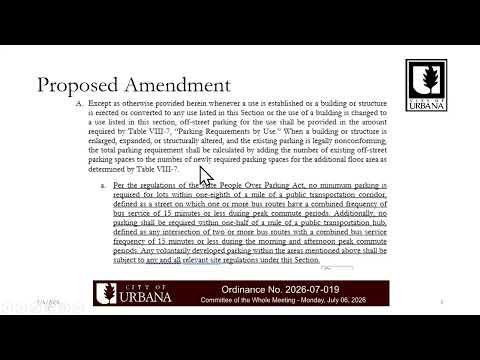
Planning staff presented ordinance 2026-07-019 to the Committee of the Whole, asking the council to amend Urbana’s zoning ordinance to bring local parking rules into compliance with the state People Over Parking Act (Senate Bill 2111).
The staff presentation said the act, signed late last year and effective June 1, prevents municipalities from imposing minimum vehicle parking requirements within an eighth of a mile of a public-transportation corridor or a half-mile of a public-transportation hub. The staff presentation noted that ‘‘a development project does not include a project where any portion is designated for use as a hotel, motel, or bed and breakfast’’ and reviewed maps showing that much of the downtown and campus-adjacent core falls within the law’s coverage. Planning staff summarized the proposed text amendment as adding the act’s definitions to the zoning code and inserting a clause that ‘‘no minimum parking is required for lots within 1/8 of a mile of a public transportation corridor’’ and ‘‘no parking shall be required within 1/2 of a mile of a public transportation hub.’'
Council members asked how the change would affect required accessible parking. ‘‘It would not,’’ planning staff said, explaining that accessible spaces are required as a ratio of a lot’s provided spaces under state standards; if a developer voluntarily provides no parking, staff said, the ordinance would not create standalone, additional accessible-parking requirements. Several members said they worried the change could push parking onto neighborhood streets as students and other users return; one council member asked whether decisions would be grandfathered for projects approved with parking and staff replied that projects approved with parking would remain approved as presented.
Mary Alice moved to forward the ordinance to the city council consent agenda; Stephanie seconded. After additional discussion the committee conducted a voice vote and the chair said the motion passed to forward the amendment to the city council for final action. Staff said they will monitor how implementation plays out statewide and locally and return with further guidance if needed.
The ordinance was presented as a compliance measure rather than a new local policy preference; staff emphasized that voluntary parking, if provided, remains subject to site-design standards including accessible spaces, dimensions and surfacing.