Get Full Government Meeting Transcripts, Videos, & Alerts Forever!
Get email alerts on the Wireless Ordinance topic
No spam. Unsubscribe anytime.
Residents urge stronger local controls as Petersburg assembly adopts wireless ordinance amendments
Summary
Residents pressed the Petersburg Borough Assembly to preserve local oversight, larger sensitive-area setbacks and more notice as the assembly approved 10 amendments and passed a wireless communication facilities ordinance on a 5-0 vote.
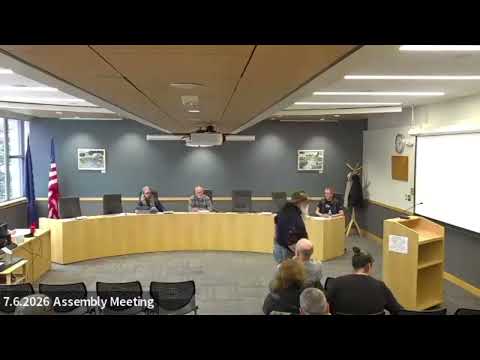
The Petersburg Borough Assembly on July 6 heard more than six hours of public testimony about a proposed ordinance setting zoning and permitting rules for wireless communication facilities before voting 5-0 to adopt the ordinance as amended.
Residents across multiple public-comment turns said the ordinance, as amended in earlier meetings, favors telecom companies and reduces local oversight. "Please do not make concessions to industry that will result in a weak wireless ordinance," said Becky Knight, who asked the assembly to restore oversight language, include more sensitive-area protections and reconsider reducing setbacks from 1,500 feet to 500 feet.
Other speakers raised similar concerns. "All of these amendments don't really seem to be serving all of the taxpayers... I feel like all the amendments have become workarounds for Title Network," Micah Klein told the assembly. Luke Short urged a moratorium until the borough can measure electromagnetic emissions: "If you do not even have the equipment to ascertain these important measurements, then I would have to state that you as a whole are remiss in your duties and a moratorium should be imposed," he said.
Supporters of local oversight warned of safety and siting risks near critical infrastructure. Tom Kowalski said towers adjacent to the fire hall and near airports raise safety concerns, noting ice buildup, traffic and the placement of diesel fuel beneath some proposed sites. "Risking damage to our fire hall, our only fire hall, is something to be seriously considered," Kowalski said.
Assembly members acknowledged the public outcry and debated the process. Member Stan Greger criticized the ordinance for appearing rushed after many amendments, saying, "If we have to do 15 amendments, we should not have brought it forward until it was done." Member Muche said staff and counsel had worked intensively to balance community protections with legal constraints and said the ordinance is a necessary first step to regulate installations that are being proposed without local standards.
Director Cabrera explained proposed changes to the conditional-use and third-party review language. The struck language would have authorized the director to require design changes; the revised language directs the director to provide third-party review information to the applicant but leaves technical design decisions to qualified engineers and the applicant, because the borough lacks authority to regulate specific engineering design.
Member Newman moved and the assembly adopted a package of 10 amendments proposed in Director Cabrera's memorandum; the roll call showed a 5-0 vote to pass the ordinance as amended. The ordinance establishes a WCF chapter in the municipal code, prioritizes colocation, sets development standards, requires conditional-use review and provides a waiver process where compliance would be technically impossible or would prevent closing a significant coverage gap.
Several commenters urged the assembly to publish industry correspondence cited at prior meetings and to define the borough's connectivity goals with specific metrics and public engagement. "These communications should be publicly disclosed," Knight said. Judy Omer reported organizers have gathered hundreds of petition signatures asking for stronger setbacks and protections for schools, childcare and assisted-living facilities.
What happens next: The ordinance will return for a third reading as required if the assembly proceeds on that schedule; assembly members said they will continue to work in the coming two weeks to refine language and consider public suggestions.