Get Full Government Meeting Transcripts, Videos, & Alerts Forever!
Get email alerts on the Short Term Rentals topic
No spam. Unsubscribe anytime.
Birmingham planning board sets Aug. 12 public hearing on 30‑day short‑term rental ban in most residential zones
Summary
The planning board voted 5‑2 on July 8 to set an Aug. 12 public hearing for an ordinance that would ban rentals under 30 days in most residentially zoned areas, while leaving downtown (D4) and the Rail (MX) districts and possible exceptions for further study.
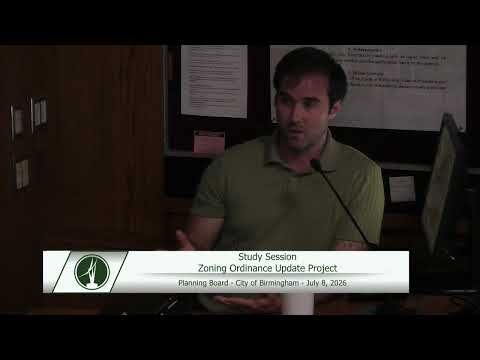
The Birmingham City Planning Board voted 5‑2 on July 8 to set a public hearing on Aug. 12 to consider zoning amendments that would ban rentals of less than 30 consecutive days in most residentially zoned areas of the city, while excluding downtown (D4) and the Rail (MX) districts from the immediate prohibition.
Chair Scott Klein said the meeting was a study session but that the board needed to move forward on an interim measure to respond to residents’ repeated complaints. “We are deadlocked on exceptions,” he said. “Hopelessly deadlocked right now,” Klein added, urging the board to advance a clear motion to the city commission and return later to unresolved nuances.
Planning staff presented a revised draft and new definitions. Nick Dupuy, the city planner who drafted the memo, outlined two central questions for the board: whether short‑term rentals should be regulated in commercial and mixed‑use districts, and whether owner‑occupied and hosted exceptions should be allowed. Dupuy told the board he was prepared to recommend an Aug. 12 public hearing on the updated language and read several definitions into the record, including “short‑term rental” (less than 30 consecutive days), “medium‑term” (30–179 days), and “long‑term” (180+ days). He also described proposed use‑specific standards requiring licensing, a minimum stay, and a prohibition on successive short stays.
Board members were divided over the scope of the ban and enforcement. Brian Williams said regulators should treat short‑term rentals in commercial zones as subject to the ordinance because many downtown buildings include residential units. “For that reason alone, I think we should regulate short‑term rentals within commercial zoning districts, period,” Williams said. Other members warned that enforcement would be difficult and that the proposed 30‑day threshold could be circumnavigated by successive stays or sublets without additional staffing or registration systems.
Members also debated exceptions for hosted rentals and owner‑occupied properties. Several members favored a limited owner‑occupied exception with day limits and registration, while others said the board lacked the data and enforcement capacity to write workable exception criteria now. The board agreed to move forward on the residential ban while deferring decisions about downtown (D4) and the Rail (MX) zone rules and any exceptions for further study.
Residents told the board the issue was urgent. One speaker who said the neighborhood had seen shootings and other safety problems asked the board to act quickly. Eric Koehler, a resident, urged the board to consider the ordinance as protecting the “fabric of community.” Another caller from Zoom, Eve Pickman, explained why the 30‑day threshold matters to law enforcement: stays of 30 days or longer can trigger registration and community notification requirements for registered offenders, a distinction she said influenced the city commission’s direction to the board.
The board’s motion, moved by Daniel Sherry and seconded by Robert (Robin) Boyle, set a public hearing for Aug. 12, 2026 to consider amendments that would prohibit short‑term rentals as defined in the packet in all areas other than the D4 and MX zones. The motion passed 5‑2 on a roll‑call vote; the board will hear public testimony at the Aug. 12 meeting and then decide whether to recommend the ordinance to the city commission. Any final ordinance would still need city commission action to take effect.
The board also discussed the broader zoning ordinance update and staff’s plan for additional public outreach, including zoning office hours and periodic surveys to collect resident input. The planning staff said it would refine findings and language before the August public hearing.