Get Full Government Meeting Transcripts, Videos, & Alerts Forever!
Get email alerts on the Public Engagement topic
No spam. Unsubscribe anytime.
Dewey Beach committee to launch resident and visitor surveys as part of comprehensive plan update
Summary
Consultants and committee members agreed to finalize and deploy a short visitor survey in mid‑July and a resident survey by September to inform the town’s comprehensive development plan; discussions focused on demographic trends, resiliency, infrastructure and ways to expand shoulder‑season activity and year‑round residency.
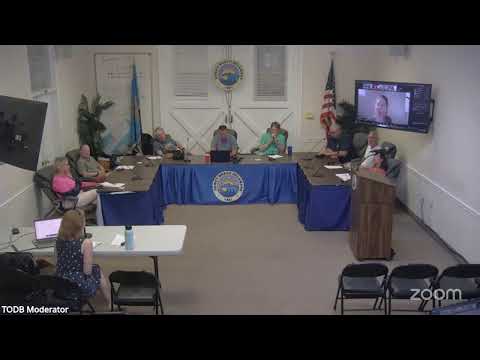
Dewey Beach’s Comprehensive Development Plan Committee on July 8 agreed to move forward with revised resident and visitor surveys meant to shape updates to the town’s comprehensive plan and public outreach ahead of a planned open house.
Jen Reitz of the University of Delaware Institute for Public Administration, the committee’s consultant, summarized demographic findings and noted both the data limits of the American Community Survey and a state requirement to use Delaware Population Consortium projections. Reitz said the town’s year‑round population is largely plateaued while the composition is changing, adding that “the age is getting older” and median home values have “basically quadrupled since 2000.” She urged members to treat ACS percentages carefully because small absolute counts can produce large margins of error.
Commissioner Gary Persinger questioned long‑term population projections and asked for clearer economic justification. “If you really believe that we’re gonna get to more than 800 people in 2050, that’s a pretty big change,” Persinger said, calling for sensitivity analyses and alternate ranges. Mayor Bill Stevens replied that aging homeowners and families making Dewey their permanent home are driving a steady increase in year‑round residents.
On the outreach strategy, the committee backed a two‑track approach: a short, roughly 10‑question visitor survey to be distributed electronically and through businesses and accommodations, and a 12‑question resident survey that includes demographic follow‑ups. Members discussed distribution options — QR codes in rental units, printed cards at hotels and eateries, paper copies available at businesses — and the use of students with tablets at an open‑house event to boost response rates. The group noted prior survey yields (about 100 usable visitor responses and 300 resident responses) and flagged timing differences between peak‑season visitor responses and shoulder‑season feedback.
Participants recommended small changes to the questionnaires: add an “other” option to rank‑order items, move an open‑ended comments question earlier in the instrument, and include one or two forward‑looking prompts (for example, “In five years, how would you like Dewey Beach to be?”) to capture visioning input. Reitz asked members to submit edits by the end of the week or the following Monday so the consultant could prepare the visitor survey for distribution by July 17; the resident survey may be launched in September to coincide with a planned open house.
Committee members also prioritized resiliency and infrastructure issues that the surveys should capture. Deborah Goldenberg Phillips and others underscored stormwater and bayside flooding work already underway and noted a consultant study on resiliency expected in about a year and 10 months. Members discussed local ordinances (impervious surface rules, increased freeboard) and recent town actions including a moratorium on new hotels and height restrictions in some areas.
Other planning topics raised during the open discussion included pedestrian safety along Route 1, year‑round commercial viability (more restaurants and a grocery store were suggested as ways to increase off‑season activity) and transportation links such as seasonal buses from New York. An attendee asked that public restrooms and additional street trash receptacles be included as possible needs for improvement on the surveys; the consultant agreed to add or retain those options.
The committee agreed to consolidate individual comments and minimize prolonged group email threads to avoid FOIA complications. Members set a follow‑up check‑in for August 12 and adjourned the meeting. The consultant will circulate a near‑final draft of the surveys for a brief review period before launch.