Get Full Government Meeting Transcripts, Videos, & Alerts Forever!
Get email alerts on the Variances topic
No spam. Unsubscribe anytime.
BMZA grants variances for rear addition to enable assisted-living access on Bel Air Road
Summary
The zoning appeals board approved variances for a rear addition at 8641 Bel Air Road to create an ADA-accessible entry supporting a residential care/assisted-living use; planning said the addition would not increase nonconformity and the applicant agreed to limit occupancy to remain below the conditional-use threshold.
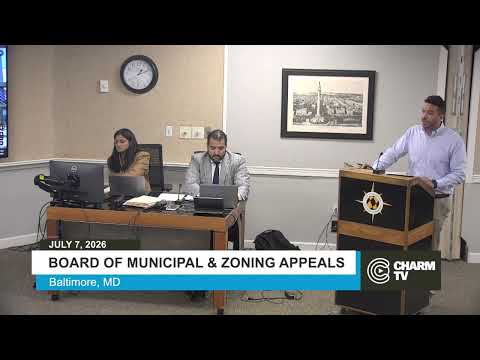
The Baltimore City Board of Municipal and Zoning Appeals on July 7 approved variances to permit a rear addition at 8641 Bel Air Road that will enable an ADA-accessible entry for a proposed residential care/assisted-living use.
Department of Planning staff summarized appeal 26O97, saying the requested variances include interior side-yard encroachments on both sides (the proposed addition would extend to within 4 feet 7 inches of the north lot line and to within 7 feet 7 inches of the south lot line where 10 feet is required). Planning told the board that the addition will not increase the degree of nonconformity but will allow a level entry into the building to support the residential care use.
The applicant confirmed the building is not currently ADA-accessible and said the 25-foot rear addition and minor front entry would create an accessible route. The applicant also addressed a planning question about occupancy: the record shows a discrepancy (plans listed 18 beds), and the applicant stated intention to keep occupancy at 16 or fewer clients so the use remains below the threshold that would require a separate conditional-use application.
A board member moved to adopt planning’s findings and the board voted to approve the variances. Planning’s recommendation and the applicant’s specified modifications (ADA access and occupancy limit) were central to the board’s decision.
Why it matters: the variances will permit structural changes to enable ADA access and a change in use toward a residential care model, with limits the applicant stated it will observe; the formal written resolution will specify conditions and the final occupancy allowance.
The board’s oral vote will be formalized in a written resolution prepared by staff and circulated to the parties.