Get Full Government Meeting Transcripts, Videos, & Alerts Forever!
Get email alerts on the Housing Development topic
No spam. Unsubscribe anytime.
Commission approves MOU with Prime Craftsman Homes to fund preliminary housing feasibility in RHID district
Summary
The Goodland City Commission approved a memorandum of understanding with Prime Craftsman Homes to split (50/50) the cost of a preliminary feasibility and predevelopment study for housing in the RHID district; the city share is roughly half of a $75,000 estimate. Commissioners acknowledged financial risk if the developer withdraws but said action is needed to attract new employers.
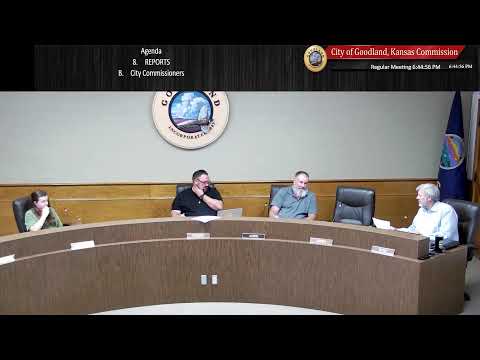
The Goodland City Commission on July 13 approved a memorandum of understanding with Prime Craftsman Homes to fund a limited preliminary planning, feasibility and predevelopment phase for housing in the RHID district. The MOU identifies a roughly 50/50 cost split; staff said the developer framed the study at about $75,000 total, leaving the city's share at approximately $37,500.
City manager Brown summarized the developer's prior presentation and said the MOU is intended to identify the scope of preliminary engineering, utility extension costs and land-development planning required to produce a reliable cost estimate. Brown said the work would not complete platting but would clarify infrastructure needs across the property, including two lots north of Toppsug Manor and a roughly 30‑acre city parcel to the west.
Mayor (speaking during debate) said the commission has no contractual guarantee to recoup the city's investment if the developer later declines to move forward; at the same time he described the proposal as “one of the better options” to address a local housing shortage that limits the city's ability to attract workers and new businesses. A commissioner asked whether the MOU or presentation included any explicit commitment for later funding; staff replied no, but said engineering costs could be rolled into future temporary construction financing if the project advances.
Commissioners discussed the financial risk versus the potential community benefit. One member said the project is a gamble but that the city needs inventory to house incoming employees, while another noted the city had set aside demolition funds in the current budget that could offset some costs. After discussion, the commission approved the MOU on a motion.
Next steps: staff will finalize the MOU and proceed with the limited predevelopment work described in the agreement. If the project advances to construction-stage financing, staff said the developer's costs for final engineering could be included in that financing package.