Get Full Government Meeting Transcripts, Videos, & Alerts Forever!
Get email alerts on the Public Safety topic
No spam. Unsubscribe anytime.
Residents press council over vehicle thefts and dark streets as police cite staffing limits
Summary
At the Sept. 18 Fairmount Heights town meeting, residents described repeated car thefts and dark blocks; Chief Moore said the department has added a third officer, will increase patrols and is coordinating with county and DC police but cited pay and hiring constraints.
Residents at a Fairmount Heights town council meeting on Sept. 18 urged the council and police to address a spike in vehicle thefts, porch-package thefts and persistent street-lighting gaps that they say leave neighborhoods unsafe.
Several residents described multiple recent crimes on blocks such as 59th Avenue and the area near Sherbro and Easton Avenues, saying cars had been stolen from driveways and porches and that some neighbors were afraid to leave their homes. “I'm really scared to come out of my house now,” one resident said, listing car thefts and break-ins. Multiple speakers asked why town police were not patrolling more consistently at night and urged installation of LED street lights and speed-calming measures.
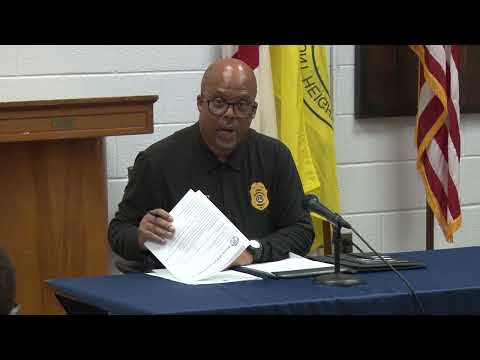
Chief Moore, who gave the police report, said the department has been coordinating with Prince George's County and Washington, D.C. police to address cross-jurisdictional crime. He described an arrest earlier that day of a 16-year-old suspect wanted on prior robbery and assault warrants and said officers are increasing patrols around school drop-off and pickup times to protect students.
On staffing, Chief Moore acknowledged limits: the town recently added a third officer who began Monday and must complete field training before solo patrols; the department remains small and is "doing so much with less." He also explained that some officers take secondary employment to supplement low municipal pay and that the town authorizes take-home cars and secondary work in line with policy. “If he gets off, is able to go to Best Buy and make $50 an hour to guard that for 4 hours ... I authorize it,” Moore said, adding that the department will still look for ways to increase local patrols.
Residents pushed back, saying they saw officers working security outside the town and that visible presence on local streets was uneven. The chief said he would personally look into specific complaints and asked residents to share camera footage and incident details so police could follow up.
The exchange underscored two persistent issues for the small town: visible police presence and lighting infrastructure. Council members and staff took notes and promised follow-up: town staff will check lighting on 59th Avenue and coordinate with public works, and the police chief said he would pursue targeted patrols and continued collaboration with county partners for Eastern Avenue and other hot spots.
The meeting closed with residents encouraged to submit photos and incident reports to the police and town staff so the town can compile evidence and pursue remedies.