Get Full Government Meeting Transcripts, Videos, & Alerts Forever!
Get email alerts on the Transportation topic
No spam. Unsubscribe anytime.
Broward County Transit outlines Oakland Park Boulevard BRT proposal for Lauderhill, targets 2030 opening
Summary
Broward County Transit presented a 15‑mile Oakland Park Boulevard Bus Rapid Transit (BRT) project to the Lauderhill commission, describing center‑running stations, signal‑priority technology (instead of dedicated lanes), anticipated ridership growth (Route 72 ~6,000→9,000 daily) and a construction start in spring 2028 with an opening target of 2030.
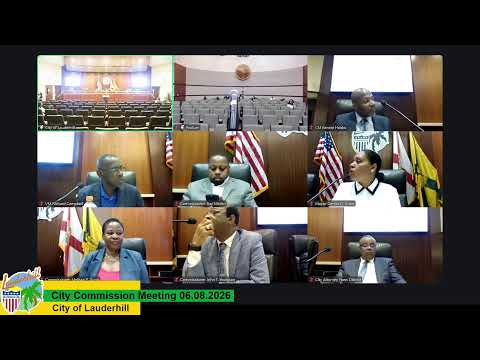
Broward County Transit officials briefed the Lauderhill City Commission on a proposed Bus Rapid Transit (BRT) line along Oakland Park Boulevard on June 8, describing the corridor scope, benefits and the planned community engagement and timeline.
CEO and general manager Corey Cuff‑Lonergan said the county’s Primo program includes a multimodal expansion that adds commuter rail, light rail and high‑frequency bus service countywide; Oakland Park Boulevard is among four large projects selected for early work. He described an overall $5 billion Primo investment over 15 years and said the Oakland Park corridor generated among the highest ridership in the county.
Abhishek Dayal, assistant general manager for capital projects, outlined project specifics: about 15 miles of corridor service, eight station pairs plus end‑terminals, an intermodal terminal concept at Sawgrass Mills Mall and center‑running station designs that create mid‑street refuges for pedestrians. County staff proposed using transit signal priority technology rather than creating fully dedicated bus lanes to avoid worsening congestion on the heavily used roadway.
Dayal said BRT service would run every 10–15 minutes, that the current Route 72 has about 6,000 daily riders and that the BRT could raise that to roughly 9,000 riders; he said the project would open new access to jobs, health care and education. The project timeline described concluding planning and conceptual engineering by fall 2026, continuing design and public outreach through 2027, beginning construction in spring 2028 and aiming for revenue service in 2030.
Commissioners and staff asked about station placement, parking and emergency‑vehicle response. County staff described curbside pullout bays and center platforms with bus pull‑through capability so buses can pull out of traffic to board; they also said intelligent signal priority systems can recognize emergency vehicles and maintain public‑safety responses.
City Manager Kenny Hobbs thanked Broward County Transit for ongoing coordination and said staff will continue technical discussions with the county and community stakeholders; no formal action was requested at the meeting.
What happens next: Broward County Transit said it will conduct additional public outreach this fall and finalize design details; construction is tentatively scheduled to start in spring 2028 with the corridor opening targeted for 2030.