Get Full Government Meeting Transcripts, Videos, & Alerts Forever!
Get email alerts on the Naval Special Warfare topic
No spam. Unsubscribe anytime.
Former SEALs at Naval Academy panel urge midshipmen to learn from Vietnam‑era training and operations
Summary
At a Naval Academy panel moderated by Admiral Nader, Vietnam‑era Naval Special Warfare veterans recounted training, missions and rescue attempts, urging midshipmen to 'not quit,' to trust enlisted sailors and to learn practical lessons from veterans' informal predeployment training.
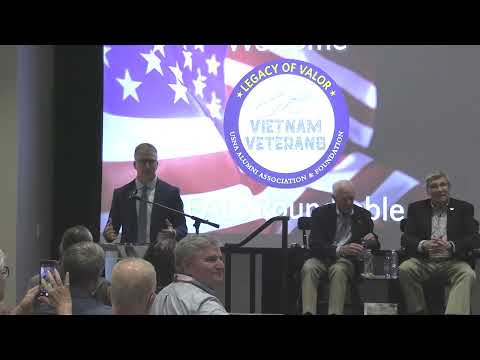
Admiral Nader moderated a Naval Academy panel in the Natter Room where four Vietnam‑era Naval Special Warfare veterans recounted how they were trained, deployed and sustained operations during the war and what lessons today's midshipmen should take from that experience. Host Jeff opened the session noting that 174 alumni from the Academy were killed in Vietnam and 39 were held as POWs, and said the panel was part of a Valor series highlighting alumni service.
The panelists described an era of steep attrition and largely improvised preparation. "We started with a 180. We graduated 40," Tom Murphy said, summarizing the high dropout rates that characterized the Class and subsequent SEAL pipelines. Murphy, class of '66, and fellow panelists Sandy Prouty (class of '67) and Couch said formal schooling before deployment was limited; units often relied on returned veterans to conduct informal, mission‑specific training and predeployment workups.
Panelists listed the practical skills that mattered most in Vietnam: small‑unit tactics, demolition, jump and parachute training, and language or cultural briefings when available. "A lot of the training never stopped the whole time," Murphy said, listing Army Ranger School, demolition and HALO training as part of what prepared him. Couch and Prouty emphasized the value of local knowledge: teams often operated with Vietnamese scouts — sometimes former VC — who provided indispensable local intelligence. "If they came to a place and said, we don't go down this path ever, we never went down that path," Couch said.
Speakers said operational support and intelligence were often unreliable, which shaped how teams planned and executed missions. Panelists praised the Seawolves, OV‑10 pilots and boat support for lifesaving fire support and extractions, recounting occasions when rapid air or boat intervention turned a dangerous situation into a successful extraction. Prouty described a mission where a damaged helicopter and close air support, including a 500‑pound strike, were part of a chaotic but ultimately successful withdrawal that left his platoon unhurt.
Audience members asked how SEAL experience translated to civilian roles. Prouty described training and standing up the FBI Hostage Rescue Team in 1982, saying SEAL experience made maritime and high‑risk rescue capabilities possible for the FBI and that cross‑training with SEAL teams was "invaluable."
When asked what trait got them through the hardest moments, panelists answered bluntly: persistence and trust. "There's an unwillingness to quit," Murphy said. Several speakers urged new officers and selectees to listen to and rely on enlisted leaders and petty officers, to build trust within the platoon, and to prepare both mentally and physically for the responsibilities ahead.
Panelists also addressed family life under repeated deployments, describing a reliance on letters, tight spouse networks and informal support groups. They recommended selectees think through the risks before volunteering and to involve families in those decisions.
The session closed with advice to the midshipmen present to "pay attention," to help less experienced teammates, and to treat leadership as both skill and relationship. The moderator opened the floor to audience questions and thanked the panelists for sharing their experiences.
The event concluded after an extended Q&A; the panelists left the room urging midshipmen to take both practical and ethical lessons from the veterans’ accounts.