Get Full Government Meeting Transcripts, Videos, & Alerts Forever!
Get email alerts on the County Budget Millage topic
No spam. Unsubscribe anytime.
Jasper County council narrows FY27 options, asks staff to run budgets at 1.155 millage and show 80/20 vs. 50/50 fire split
Summary
At a June budget workshop, Jasper County council debated whether to base the rural fire/EMS funding split on an 80/20 call‑volume model or a different ratio, heard that reaching lower millage targets would require $4.2M–$7.6M in cuts, and directed staff to present revised budgets using a 1.155 operating millage baseline by next Monday.
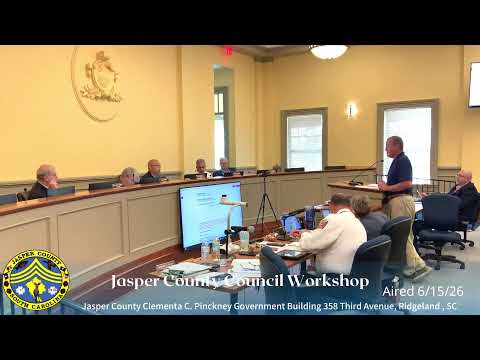
Jasper County council members spent a budget workshop debating how much taxpayers should pay next year and how to split rural fire and emergency medical services costs.
Staff outlined three primary options and distributed a spreadsheet with 10 sample properties showing the tax impact in both incorporated and unincorporated areas. A staff member (S4) told the council, “I think that 1.45.5 in the unincorporated area is about the number that we can get to without making drastic cuts to existing services.” He warned that cutting deeper to a 1.39 millage would require about $4.2 million in reductions and that a 1.30 target would require roughly $7.6 million in cuts from the package presented at the prior work session.
The meeting’s most contested technical issue was how to apportion costs between fire and EMS. Staff recommended an 80/20 split based on call volume; several council members questioned whether every dispatch that sends both a fire truck and an ambulance should be counted as a fire call. One council member (S2) asked whether routine public‑service responses — the example offered was a ladder for a cat stuck in a tree — should be tallied as a fire incident, noting that dispatch practices affect the ratio and therefore the rural millage.
Staff and council also discussed rollback math and the meeting’s baseline assumptions. Staff confirmed that the commonly referenced “1.09” rollback reflects the rate without growth and said starting from that rollback then adding growth would return taxpayers to last year’s overall burden. A council member (S5) noted that certain commitments and signed contracts (debt for apparatus, pumpers and other equipment) add at least $1.2 million that cannot be rolled back, meaning a straight rollback would not cover mandated expenditures.
Beyond the fire/EMS split, councilors pressed for clearer line‑item transparency. Several members said they wanted more granular performance and accounting reports before approving deep cuts; one (S1) said he wanted to stop payments if a department exceeded a line item without explicit council approval. Staff replied that they do not routinely move money between line items and that some apparent overages may reflect timing (for example, a contract paid early in the fiscal year).
On program and capital questions, a council member (S2) asked why Parks and Recreation showed $1.2 million in ATAX revenue while only $327,000 appeared in the operating budget. Staff (S6) said the remainder is in capital outlay/CIP and is being funded with cash carryforward for tourism‑related projects, including Sergeant Jasper Park.
After exchanges about scenarios and departmental cuts, council members asked staff to return with a revised package. Staff said they had already reduced the draft by about $1.5 million and proposed a working baseline of a 1.155 operating millage. The council directed staff to prepare updated budgets using that 1.155 baseline, to present comparisons of 80/20 and 50/50 fire/EMS splits, and to show where requested position additions and a 5% cost‑of‑living adjustment would land the millage. S4 confirmed staff would provide the spreadsheet so members could adjust the top‑line millage and see computed impacts for the provided sample properties.
The workshop concluded with the council adjourning and returning to executive session to continue earlier closed‑door matters. Staff committed to deliver the revised numbers and specific cut lists by the following Monday.