Get Full Government Meeting Transcripts, Videos, & Alerts Forever!
Get email alerts on the Homelessness topic
No spam. Unsubscribe anytime.
Resident urges end to Lake City’s bench program, proposes two safety ordinances; council schedules workshop
Summary
A Lake City resident asked the council to let the city’s 90‑day Blue Bench contract expire and to adopt two safety‑focused ordinances limiting median presence and pedestrian‑motorist interactions; the council set a July 20 workshop to review legal and enforcement implications.
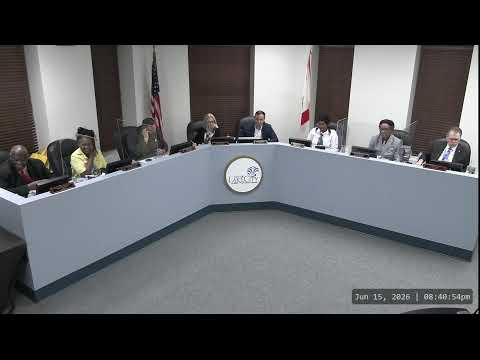
Christian Quadris, a resident who said he has researched local ordinances, urged the Lake City Council on June 15 to let the city’s 90‑day extension on the Blue Bench program lapse and to adopt two narrowly drafted public‑safety ordinances to reduce pedestrian hazards on high‑speed roadways.
Quadris told the council the benches—installed as commuter resting spots—have become encampment sites and are concentrated on Highway 90 and on Main Street near Duval. He proposed (1) an ordinance that would create a 6‑foot safety buffer from roadways and prohibit standing, sitting or lying in hazardous medians and roadside easements in areas posted at 30 mph or higher; and (2) a separate ordinance restricting hazardous transactions and physical interactions between pedestrians and vehicle occupants in rights‑of‑way. Quadris said the language would provide a 30‑day public‑education grace period, allow limited exemptions for maintenance and emergency personnel, and include fines and municipal penalties to give enforcement teeth.
“Right now our police and sheriffs tell me their hands are tied,” Quadris said, describing conversations with law enforcement and arguing the measures are safety, not speech, rules: “This is strictly when the language of the ordinance is 100% based in safety.”
City Attorney Robert Martin told the council that regulating activity in medians has legal precedent, but that restricting activity on sidewalks and broad speech restrictions are more legally vulnerable. Martin said staff has begun reviewing case law and would recommend next steps, and he suggested the council host a focused workshop to work through the legal gray areas before drafting an ordinance.
Council members expressed mixed reactions. Several members, including Councilwoman Young, said they were sympathetic to safety concerns but worried an ordinance would simply shift the problem into residential neighborhoods. Councilmember Carter urged prudence based on past litigation in other jurisdictions and recommended robust research and outside expertise at a workshop. Mayor Walker and other council members said they wanted a multi‑pronged approach that includes homeless‑service partners such as the United Way and the county.
After discussion the council agreed to schedule a workshop on July 20 at 5 p.m. Staff said it will invite law‑enforcement partners, the homeless coalition and other stakeholders and will review case studies and draft language that attempts to limit legal exposure while addressing the safety issues Quadris described.
The council did not vote on an ordinance that night; members said the workshop will provide the forum to refine language and clarify enforcement and magistrate roles.