Get Full Government Meeting Transcripts, Videos, & Alerts Forever!
Get email alerts on the Short Term Rentals Zoning topic
No spam. Unsubscribe anytime.
Birmingham boards debate short-term rental limits and zoning rewrite; motion to ban STRs in residences withdrawn
Summary
Planning staff presented research on short-term rentals and zoning changes; commissioners debated banning STRs in residential zones, allowing them in some commercial districts, or imposing owner-occupied carve-outs. A motion to eliminate STRs in residential areas was proposed and withdrawn after the city attorney said action could not be taken during an existing moratorium.
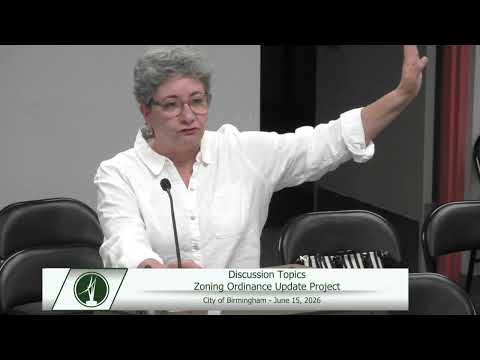
At the same June 15 joint meeting, planning staff updated the City Commission and Planning Board on ongoing work to rewrite Birmingham’s zoning ordinance and to recommend short-term-rental (STR) rules.
Planning Director Nicholas Dupuy (introduced by the mayor) said the consultant’s review of the existing ordinance and public engagement is under way and that the staff will provide draft ordinance language following legal review. Scott Klein, chair of the planning board, summarized mapping that shows clusters of certified rentals and said about 22% of the city’s housing units appear on the certified-rental list — noting that nearly half of those are apartments.
Discussion among commissioners and planning board members centered on whether to prohibit STRs in single-family residential districts while allowing them in some mixed-use and commercial areas such as the Rail District or the Triangle District, where short-term stays might support downtown activity. Other commissioners warned that concentrating STRs in a few districts could destabilize housing and push investors into limited areas.
One commissioner moved to eliminate short-term rentals under 30 days in all residential zoning areas effective immediately, with a narrow owner-occupied exception. The motion was seconded, but the city attorney advised that the commission could not take that action at this joint workshop because a prior moratorium/resolution was already in place and procedural notice would be required; the mover then withdrew the motion.
Planning board members flagged legal and enforcement complexities: mixed-use buildings that combine ground-floor commercial uses with residential units, potential state-law constraints, and the difficulty of policing owner-occupancy claims (residency rules can allow owners to rent parts of their primary residence extensively under some interpretations). Planning staff asked commission members whether they wanted the board to study owner-occupied carve-outs; the commission said staff should continue analysis and work with the city attorney to craft legally defensible language.
Hosts and owners who addressed the board during the second public-comment period said many licensed owner-occupied rentals operate without incident and that platform controls (minimum-night stays, ID checks, review thresholds) and bonding or insurance requirements could reduce bad actors without a full ban. Residents and other commissioners stressed enforcement capacity and recommended improved cross-department reporting (police, building, zoning) and publication of rental maps to help neighborhoods monitor known rentals.
Commissioners asked staff for a written legal opinion on what restrictions are permissible in commercial and mixed-use districts and for draft ordinance language that balances neighborhood protection, enforceability and the city’s interest in downtown vitality. Planning staff said the consultant’s next deliverable is expected in late June or early July and that they will return with recommendations and a legal analysis.
The commission did not adopt new regulations at the meeting; staff and the planning board will continue to develop ordinance proposals and enforcement mechanisms for future public hearings and formal votes.