Get Full Government Meeting Transcripts, Videos, & Alerts Forever!
Get email alerts on the Economic Development Tif topic
No spam. Unsubscribe anytime.
Morgan County approves TIF for western economic-development area amid heated public comment on proposed data center
Summary
After a Baker Tilly presentation on TIF mechanics, Morgan County commissioners voted 3-0 to establish the Western Morgan economic development area tied to a proposed data center. Residents raised concerns about water use, noise, school funding and whether the county favored a single company.
Commissioners approved resolution 2026-6-15 to establish an economic development (TIF) area covering the western portion of Morgan County after a presentation from the county’s redevelopment representatives and municipal advisors.
Chelsea Manns, who represented the Morgan County Redevelopment Commission, introduced Sam Schrader of Baker Tilly Municipal Advisors. Schrader explained how a tax-increment financing (TIF) area works: the county sets a base assessed value for the allocation area and the redevelopment commission can spend tax revenue from any growth above that base on infrastructure and other public improvements inside the designated economic development area. He said permitted uses include capital projects, roadway and utility work, site acquisition, public safety capital projects and quality-of-life investments such as parks and childcare supports.
Schrader described modeling for a potential data center at the site. He said one data center building could generate roughly $280 million of assessed value on the real-property side; under a hypothetical 10-year, 50% real‑property abatement scenario Baker Tilly estimated about $14 million of assessed-value increment would be captured by the RDC in early years. Schrader cautioned the numbers depend on final assessments and any abatement terms. He estimated that, in the abatement scenario shown, overlapping taxing units combined would see modest downward pressure on tax rates but the RDC would forgo several hundred thousand dollars of net TIF revenue in early years (figures presented in the meeting materials showed a cumulative foregone net TIF revenue on the order of hundreds of thousands of dollars under the example scenarios).
Commissioner discussion focused on local impacts. Commissioners asked Baker Tilly to confirm that the TIF does not directly create new operational dollars for schools that are levy‑limited and that the RDC captures only incremental assessed‑value growth above the established base. Commissioners and staff also discussed how abatements, potential revenue-sharing and future bond issues could affect taxpayers and fire and EMS budgets; Baker Tilly said captured increment can be used to supplement projects but stressed the statutory and technical limits on how levies and captured value interact. Commissioner Brian Collier described signing a nondisclosure agreement as part of commercial negotiations and said commissioners face a choice between capturing revenues for targeted projects and raising countywide levies to pay for infrastructure needs.
The meeting drew an extended public-comment period. Neighbors and residents voiced concerns and requests that shaped the debate: questions about whether the RDC or county holds title (chair said the RDC/contract arrangements are public record), requests for copies of lease documents, worries about noise and the low-frequency hum from equipment, questions about water use and river impacts, calls for revenue-sharing with Monroe‑Gregg Schools, and pleas to prioritize neighbors and small businesses rather than appearing to favor a single large company. Representative public comments included:
- Jason Whitlow, who asked whether lease payments and tax responsibilities were transparent and was told leases are public record and that the site was under a triple‑net arrangement with the occupant paying taxes. - Sean Walker, a resident living adjacent to the project, who said neighbors have felt sidelined and urged the county to weigh neighbor and small-business interests more heavily. - Andy Tower and Andrew Grismore (incoming superintendent of Monroe‑Gregg Schools), who urged consideration of school impacts and potential revenue‑sharing arrangements.
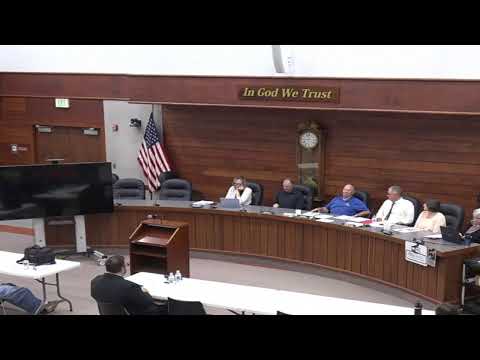
After the presentation and public comment, Commissioner (speaker 2) moved to approve the resolution; a second was offered and the three commissioners present voted to approve the economic development area (motion passed 3-0). Chelsea Manns said the RDC will hold a confirmatory resolution and public hearing on July 15; county staff noted the base assessed value that will be used to calculate captured increment will reflect the official pay‑27 / Jan. 1 valuation once finalized.
What happens next: the redevelopment commission must adopt a confirmatory resolution and hold a public hearing (scheduled July 15 in the meeting discussion). The county and RDC will finalize the base assessed value used to calculate captured increment; any future abatements or revenue‑sharing agreements would be separate actions requiring additional approvals. The commissioners and speakers repeatedly characterized TIF as a tool to fund targeted infrastructure in the area but warned it carries tradeoffs for overlapping taxing units and for how and when dollars are available.
Vote at a glance: resolution 2026-6-15 establishing the Western Morgan economic development area — passed 3 to 0 (motion by Commissioner (speaker 2); seconded by Commissioner (speaker 10)).