Get Full Government Meeting Transcripts, Videos, & Alerts Forever!
Get email alerts on the Housing Funding topic
No spam. Unsubscribe anytime.
Broomfield housing division seeks $640,000 shift to sustain programs, prioritize seniors and preserve development fund
Summary
Housing staff proposed reallocating $640,000 in local funds to expand a Broomfield Older Adult Assistance program and preserve the Housing Development Fund for land acquisition and gap financing; council queried program scope, budget tradeoffs and outreach to prior beneficiaries.
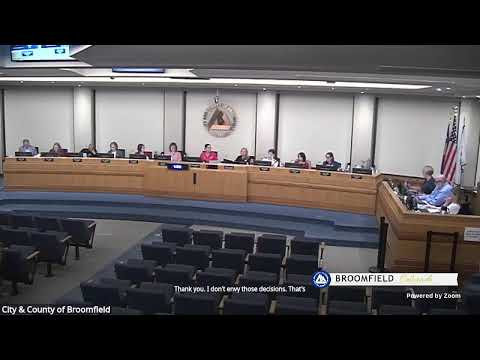
Broomfield’s housing division presented a 2026 update on June 16 and asked the council to approve a $640,000 general‑fund allocation to support two housing programs and preserve the Housing Development Fund (HDF) for development financing.
Housing policy manager Sharon Tessier told the council the division currently serves roughly 1,300 households annually and expects about 400 income‑aligned units to come online through 2027. Tessier said the department leverages $4–$10 for every local dollar spent and described three income buckets of need. To protect the HDF for land acquisition and gap financing, staff proposed transitioning the property‑tax partial refund program (PPTR, about $600,000) and $40,000 from the Sunshine Home Share program into a Broomfield Older Adult Assistance (BOA) program.
Tessier said BOA would have two arms—homeowner assistance and renter assistance for seniors—and would shift from a first‑come, first‑served refund to a needs‑prioritized grant. She described proposed flat grant tiers for homeowners: a $1,100 annual flat grant for households at 0–30% area median income (AMI), $800 for 31–50% AMI and $600 for 51–60% AMI; households at 61–80% AMI would be ineligible under the proposed configuration so that funding focuses on the most vulnerable.
Council members sought specifics. Staff estimated roughly 100 households fall in the 61–80% AMI band that may lose eligibility under the new structure; Tessier and staff said they would mail notices and proactively contact prior PPTR recipients to explain program changes. Councilors also asked for cost estimates to broaden eligibility and for the tradeoffs used to assemble the $640,000 (city manager: a combination of departmental delays, deferred vehicle replacements and other adjustments across several budgets). Tessier said the department will provide requested supplemental figures.
The presentation emphasized that federal and state funding sources are limited by program rules (CDBG, HOME, CSBG) and that local dollars have enabled a range of programs—home repair, down‑payment assistance, mobile‑home park support and an expanding voucher program—that together aim to prevent displacement and support seniors and vulnerable residents. Tessier said the housing division has leveraged state Prop 1.2.3 down‑payment assistance, expanded housing vouchers (Broomfield Housing Alliance) and will provide updated housing needs assessment and inclusionary housing ordinance analyses later this year.
Council members voiced support for prioritizing the most vulnerable but expressed concern about long‑term sustainability and the need for dedicated, stable funding sources. Staff and the manager said the allocation would be part of larger budget conversations that continue through the fall and into 2027 and that program parameters could be adjusted once supplemental cost modeling and outreach results are available.
No formal appropriation occurred at the study session; council directed staff to return with the requested details as part of upcoming budget deliberations.